Most first-time car owners fall into one of two camps: they obsess over every noise the first month, then forget about the car entirely once things seem fine, or they ignore maintenance completely until something expensive breaks. Both approaches cost money. The good news is that this beginner DIY car care checklist for 2026 gives you a straightforward fix: a realistic monthly routine, current service intervals, and a clear line between what you can handle yourself and when to call a professional.
Owning a car feels like everyone around you already knows what they’re doing. No one teaches you how to check your oil in school, and calling a mechanic for every small question gets expensive fast. This DIY car care checklist for 2026 covers everything a new car owner needs to start right: a realistic monthly walk-around, updated service intervals, a starter tool kit with honest cost estimates, EV and hybrid differences, and a practical sense of when to step back and let a professional take over.
Qurabox updates this guide every year to reflect current vehicle standards, so bookmarking it gives you a reliable reference point every season. Whether you drive a 2024 gas-powered sedan or a 2026 electric crossover, the fundamentals here apply.
Your beginner DIY car care checklist: the 10-minute monthly walk-around
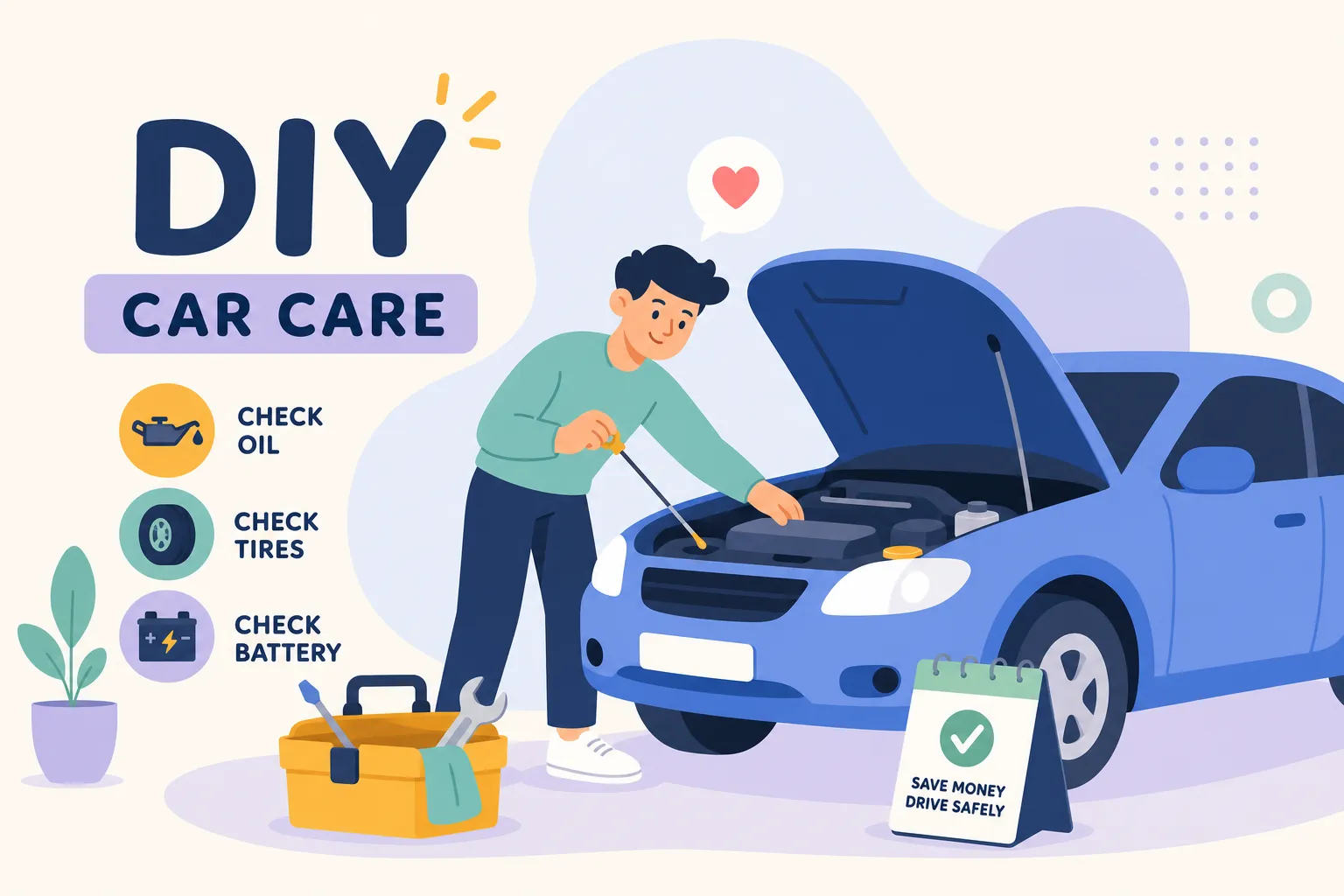
A 10-minute monthly habit catches most problems before they turn expensive. You won’t need tools for most of these checks. Start with your eyes, a tire pressure gauge, and your owner’s manual within reach.
Lights, tires, and visible damage
Before you open the hood, walk the perimeter of your car slowly. Check your headlights, brake lights, turn signals, and parking lights. If you’re doing this solo, use the reflection from a wall or garage door to verify your brake lights, or place a heavy object on the pedal while you walk behind the car.
While you’re circling the vehicle, look at each tire. Scan for sidewall bulges, any obvious low pressure that makes the tire look soft, and nails or debris lodged in the tread. Also glance at the ground directly under where the car was parked overnight. Fresh drips are worth investigating before you drive.
Under-hood fluid checks: oil, coolant, and washer fluid
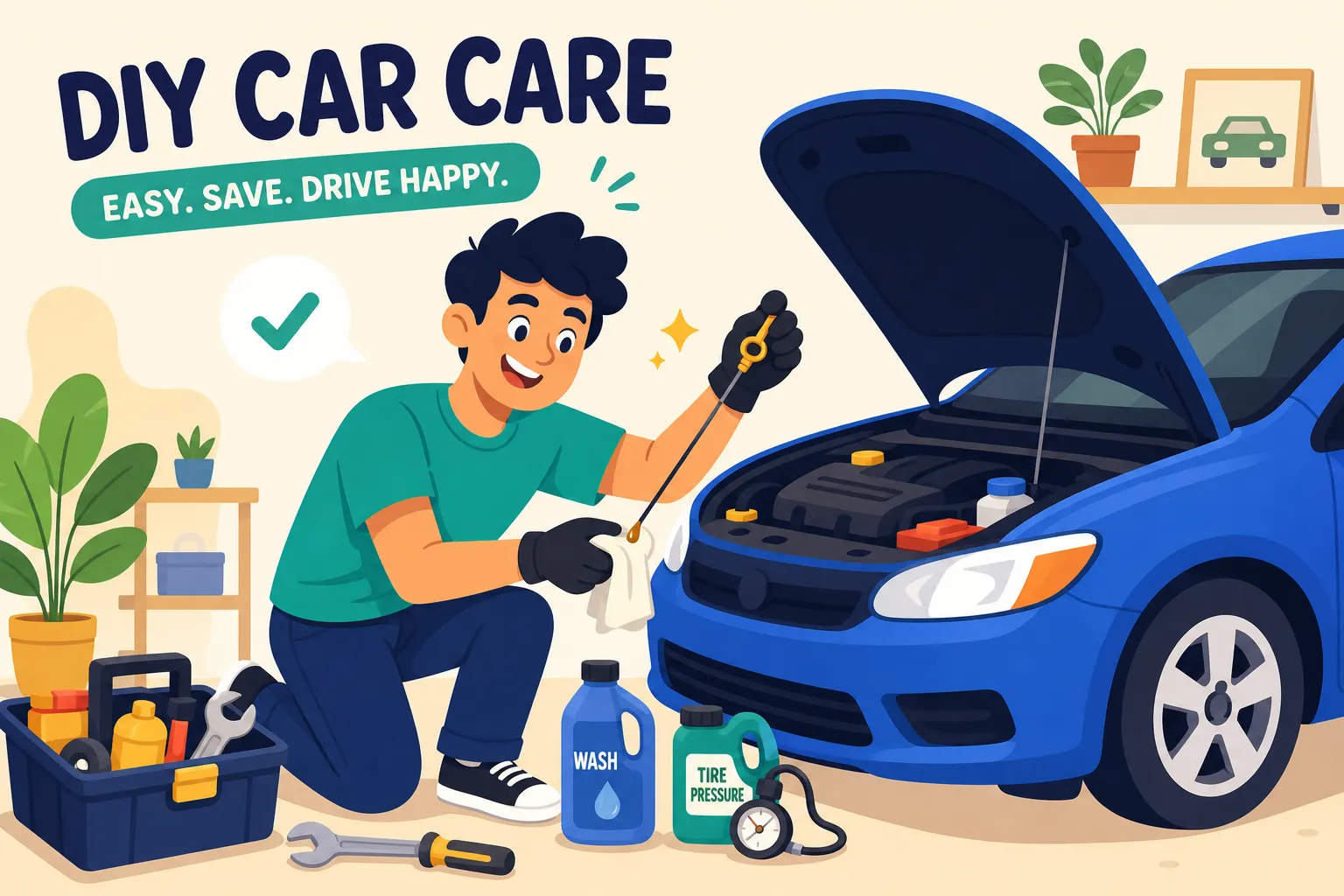
Check engine oil when the engine is cold or has been sitting for at least 10 minutes. Pull the dipstick, wipe it clean, reinsert it fully, pull it again, and read the level. The oil should fall between the two marks. Color matters too: fresh oil is amber, old oil is very dark. Washer fluid is the easiest top-off in automotive maintenance, pull the cap with the windshield symbol and fill it up.
Coolant checks require patience. Only inspect the coolant reservoir when the engine is fully cool, and never open the radiator cap on a warm engine. Many 2024, 2026 vehicles use sealed or semi-sealed cooling systems, so the reservoir is the only safe access point. When in doubt, your owner’s manual overrides every general guideline on this one.
Tire pressure and tread depth: two checks beginners often skip
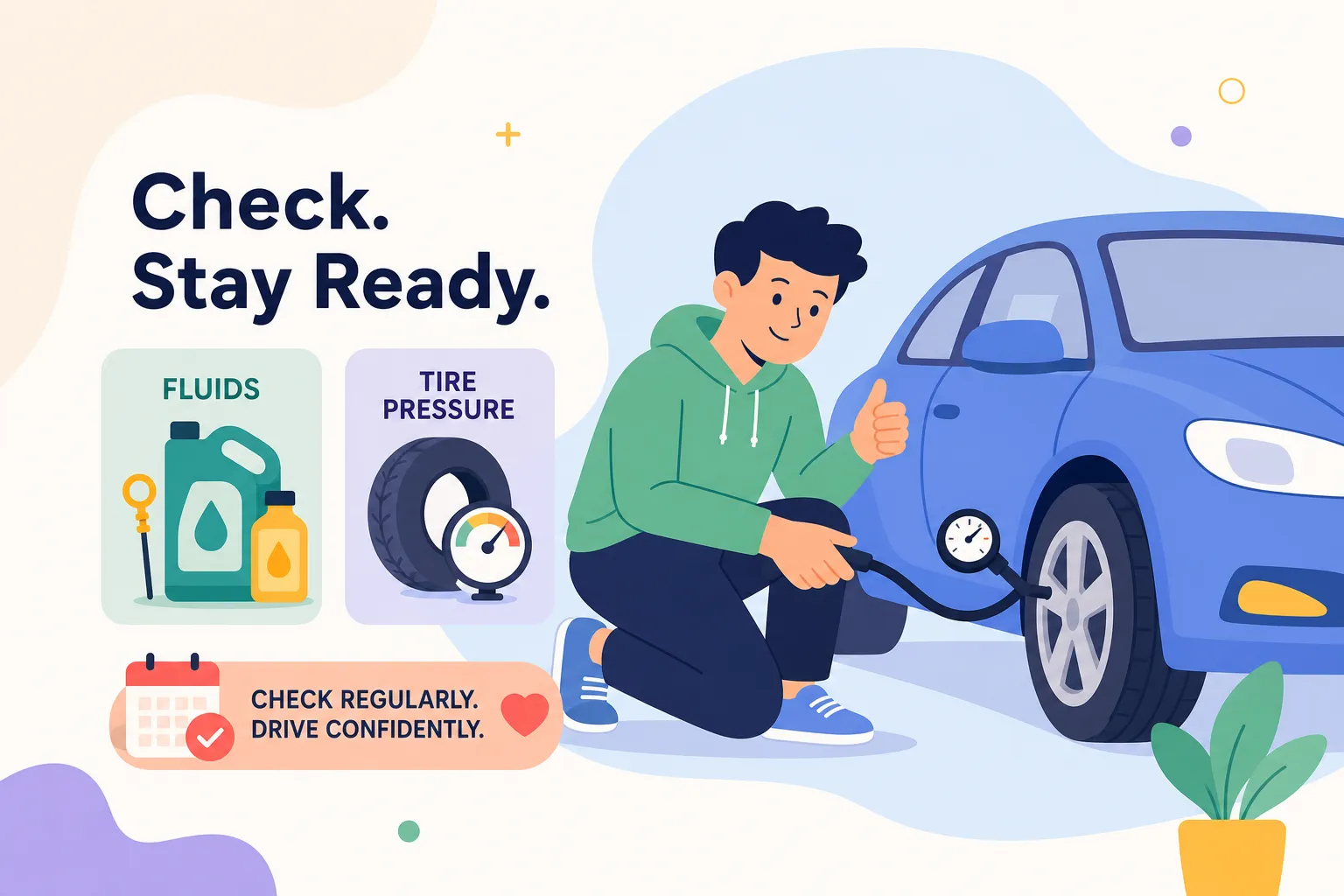
Find your correct tire pressure on the door-jamb placard, usually on the driver’s side door frame. The number on the tire sidewall is the maximum pressure the tire can hold, not your target. Check pressure when the tires are cold, before you’ve driven more than a mile.
For tread depth, use the penny test: insert a penny into the tread groove with Lincoln’s head pointing down. If you can see the top of Lincoln’s head, your tread is low and replacement is coming soon. Check the spare tire too. A flat spare sitting in your trunk is useless on the side of the highway.
Service intervals every beginner should know: 2026 DIY car care checklist
The old “change your oil every 3,000 miles” rule is outdated for almost every vehicle built in the last decade. Applying it to a 2026 vehicle means you’re spending money on unnecessary service. Here’s what current manufacturer guidance actually looks like.
Oil, air filter, and tire rotation: the updated schedule
Most 2026 vehicles running full synthetic oil have recommended intervals of 7,500 to 10,000 miles or 12 months, whichever comes first. Many newer models use an oil-life monitor on the dashboard rather than a fixed mileage schedule. When that indicator drops to around 15%, it’s time to schedule a change. A DIY full-synthetic oil change typically costs $32 to $47 in materials, compared to $65 to $125 at a shop, making it one of the highest-value beginner tasks to learn.
Engine air filter inspection falls around every 15,000 miles, with replacement at 15,000 to 30,000 miles depending on your driving environment. Dusty roads and unpaved surfaces shorten that window considerably. Tire rotation should happen every 5,000 to 7,500 miles, which works out to roughly every other oil change for most drivers.
Brakes, coolant, and belts: longer-cycle items beginners forget
Brake pads are inspected at every tire rotation and replaced when worn or when squealing begins. Coolant service typically falls every 2 to 5 years or 30,000 to 100,000 miles depending on coolant type and your vehicle’s requirements. The serpentine belt on most 2026 vehicles is good for 60,000 to 100,000 miles, but inspect it during routine under-hood checks for cracking, glazing, or fraying.
These are general benchmarks, not universal rules. The maintenance schedule in your owner’s manual is the authoritative source, and 2024, 2026 vehicles vary significantly by manufacturer and model.
The starter tool kit: what you actually need and what it costs
Buying too little means you can’t finish the job. Buying too much means spending money on tools you’ll never use. The right approach is a tiered kit: start with hand tools for basic checks and top-offs, then add lifting gear when you’re ready for oil changes and tire work.
Essential hand tools for basic car maintenance
The core kit covers most tasks: a socket set with ratchet ($30, $100), a combination wrench set ($20, $60), a screwdriver set ($10, $25), and a set of pliers ($15, $40). Add a quality tire pressure gauge ($5, $20) and an OBD-II code reader ($20, $50). The code reader alone is worth buying early, it lets you read a check-engine light before driving to a shop, which prevents being quoted repairs you may not need. The FIXD Bluetooth scanner and Launch CR529 are two beginner-friendly options under $50. A lean, functional hand-tool setup runs $100 to $200.
Safety gear and lifting equipment: non-negotiables
For any under-car work, you need a floor jack ($60, $150), a quality pair of jack stands ($30, $80), and wheel chocks ($10, $25). These are not areas to cut corners: cheap lifting gear is a safety risk, not a bargain. Add mechanic gloves ($10, $25), safety glasses ($5, $15), a work light ($10, $30), and a drain pan ($10, $25) for fluid changes.
A complete, safe beginner setup including lifting gear runs $200 to $400. That’s a one-time investment that pays back fast when you start doing your own oil changes at half the shop price.
How EV and hybrid maintenance differs from a gas car
Electric vehicles are common among first-time buyers in 2026, and applying gas-car logic to an EV leads to either wasted money on services you don’t need or missed services on systems you didn’t know existed. Any complete beginner car care checklist for 2026 needs to address EV maintenance basics separately.
What EVs skip entirely
EVs have no engine oil to change, no spark plugs, no fuel system, and no timing belt, these tasks disappear from your preventive car maintenance schedule completely. Brake pad replacement is also less frequent because regenerative braking handles most deceleration, which significantly reduces pad wear.
Fewer routine services don’t mean no maintenance; they mean the tasks shift to different systems. That distinction matters for budgeting your time and money as a new EV owner.
What gets more attention: battery, cooling, and tires
Battery health monitoring is the EV equivalent of engine care. The high-voltage system should only be inspected or serviced by a certified EV technician, high-voltage components require specialized tools and training that go well beyond beginner DIY territory. Battery and power electronics cooling loops also need periodic checks and manufacturer-specific coolant service.
Tires deserve extra attention on EVs. Battery weight makes EVs heavier than comparable gas vehicles, which accelerates tire wear. Many EV manufacturers, including Tesla, recommend rotation intervals of every 5,000 to 6,000 miles, though model-specific schedules vary, so check your owner’s manual for the exact figure. Hybrids are different: they still have a gasoline engine that requires all conventional maintenance, with battery and electrical system checks layered on top.
Warning signs that mean stop DIYing and call a mechanic
Knowing your limits is part of being a capable DIY car owner. These are the specific symptoms that move beyond basic maintenance and into professional territory.
Dashboard lights, leaks, and burning smells
Any warning light beyond the oil or tire pressure reminder warrants a professional diagnostic scan. Check engine, ABS, transmission, and brake system lights are not situations where you read the code and hope for the best. A quality OBD-II reader can tell you the code, but interpreting and fixing what’s behind it often requires hands-on expertise.
Fresh fluid puddles under the car each have a distinct identity. Oil runs dark brown to black. Coolant is typically green or orange with a sweet smell. Brake fluid is clear to light yellow. Transmission fluid is red. Any active leak is a reason to investigate before driving further. Smoke from under the hood or a burning smell from anywhere on the car means stop immediately, both signal overheating or an electrical problem.
Sounds and performance changes above the DIY threshold
Grinding or squealing brakes may indicate worn pads, but warped rotors or caliper issues need hands-on inspection to diagnose correctly. Knocking or rattling from the engine points to internal problems that no walk-around check will address. Slipping gears, rough shifts, or sudden loss of power are transmission and drivetrain issues that require professional diagnosis without exception.
Vibration through the steering wheel at highway speed is trickier: it can be as simple as an out-of-balance tire or as serious as a worn suspension component. The distinction requires someone to get under the vehicle and look. Don’t guess on anything steering or brake-related.
Building your personal vehicle maintenance schedule
A checklist only works if it becomes a habit. The goal is to turn this information into a repeatable system that runs in the background of your regular routine.
Monthly, quarterly, and annual tasks at a glance
- Monthly: 10-minute walk-around covering lights, tires, oil level, and washer fluid. Pick a consistent date, like the first Sunday of each month.
- Quarterly: Check battery terminals for corrosion, inspect wiper blades, and do a visual check of belts and hoses.
- Every 6 to 12 months or per mileage: Oil change, tire rotation, air filter inspection, and brake inspection. Let the owner’s manual set the exact interval.
- Annual: Full fluid review (coolant, brake fluid, transmission fluid), cabin air filter replacement, and a pre-winter or pre-summer inspection based on your region.
Using your owner’s manual and setting reminders
The owner’s manual maintenance schedule is the single most authoritative source for any 2024, 2026 vehicle. Photograph the maintenance schedule page and save it to your phone’s camera roll. That gives you immediate access when you’re standing in an auto parts store or talking to a service advisor.
Set monthly calendar reminders for your walk-around checks and use your car’s trip meter to flag mileage milestones. Qurabox publishes updated seasonal checklists each year covering winter prep, spring checks, summer heat protection, and fall readiness, bookmarking the site gives you a built-in annual review prompt timed to when those checks actually matter.
You’ve already done the hardest part
Car maintenance doesn’t require mechanical expertise. It requires consistency and knowing what to look for. Start with the monthly walk-around, build toward the longer-cycle services, and use your owner’s manual as the final word on intervals specific to your vehicle.
Use this beginner DIY car care checklist for 2026 to build a simple habit that saves money and reduces stress. Qurabox updates this guide annually to reflect current vehicle technology, the latest synthetic oil intervals, EV-specific service requirements, and updated tool costs. Return each season for the updated version before winter sets in or before a long summer road trip.
The first time you catch a slow tire pressure drop before a long drive, or top off your oil before a highway trip instead of waiting for a warning light, the effort pays for itself. That’s the whole point of building this habit now.