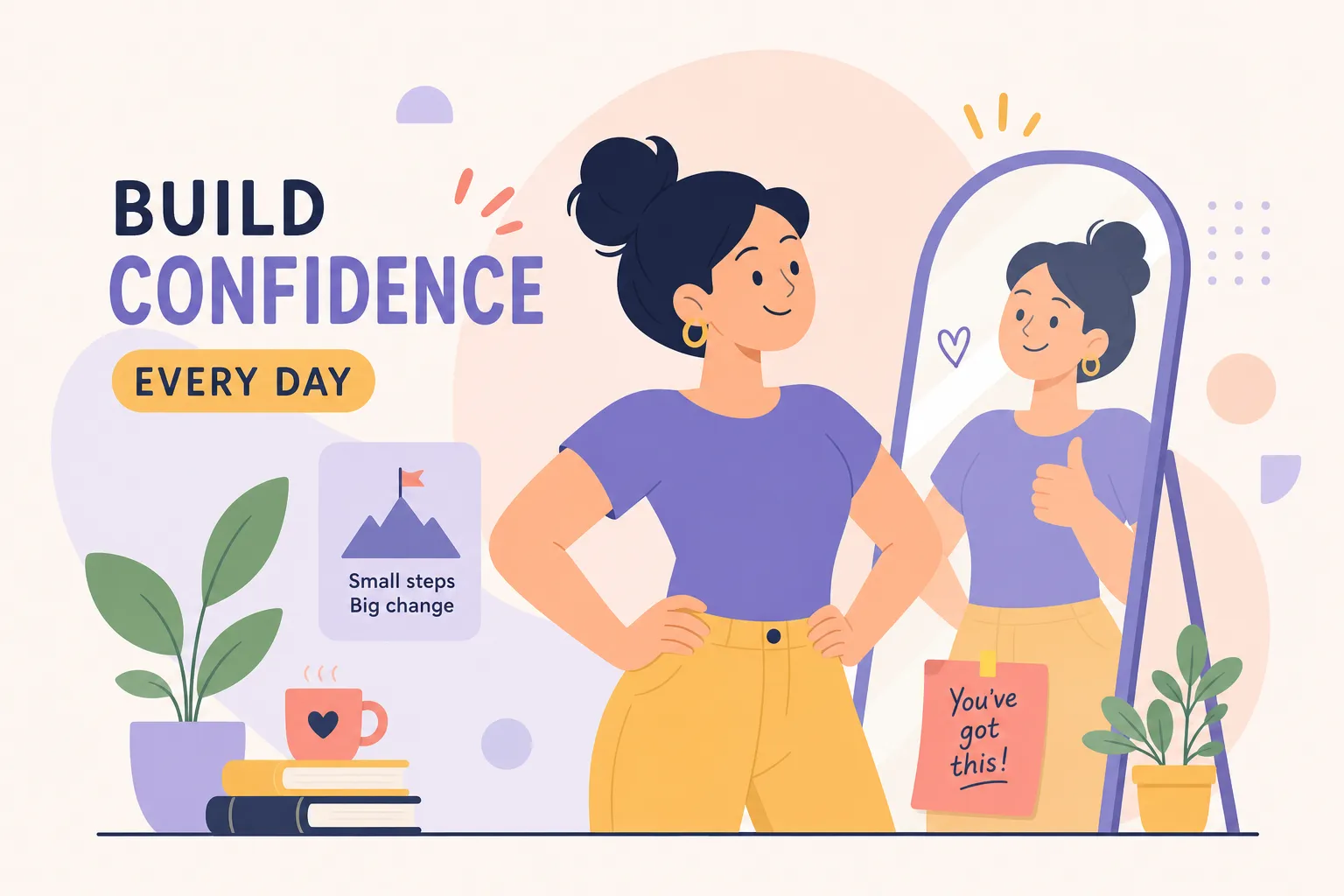
If you’re searching for the fastest science-backed ways to boost self-confidence in 2026, you’ve probably already tried the standard playbook: repeating mantras, visualizing success, waiting until you feel ready. Those approaches often produce inconsistent or small effects compared with action-first methods, and the research explains why. Belief follows behavior, not the other way around. When you act first, your brain collects evidence that updates what you believe you’re capable of doing.
Standard advice like “fake it till you make it” or generic positive self-talk lacks consistent experimental support when put through rigorous testing. A growing body of behavioral science research from 2020 to 2026, including a 2023 review covering 22 RCTs on behavioral activation and BA-plus-mindfulness trials documenting two-week mechanism shifts, points to specific, evidence-based confidence strategies that produce measurable self-efficacy gains in documented timelines. Here at Qurabox, we read through peer-reviewed studies so you don’t have to, then translate that research into practical steps you can actually use. This article gives you the three strongest evidence-based methods, their realistic timelines, and a 7-day tracking plan to measure your early gains. If you want the broader system around habits and wellness, Qurabox’s guides on daily routines and self-improvement cover that foundation in detail.
Why most confidence advice fails the speed test
The gap between popular confidence advice and what experimental research supports comes down to one core misunderstanding: most motivational approaches target beliefs first. Psychology research consistently shows the reverse is more effective. Behavior changes beliefs faster than beliefs change behavior. This is not a motivational claim; it’s the central mechanism behind Albert Bandura’s self-efficacy framework, one of the most replicated models in behavioral science.
Mastery experiences sit at the top of Bandura’s hierarchy as the most powerful source of self-efficacy gains. When you complete an action and observe the result, your brain updates its estimate of what you can do. No affirmation or visualization produces that update as directly or durably as the act itself. Before you pick a method, it helps to understand what “fast” actually looks like in the research.
What randomized controlled trials from 2020 to 2026 actually measured
Most recent randomized controlled trials measure self-esteem, mastery, or self-efficacy rather than “confidence” verbatim. For practical purposes, these constructs are functionally interchangeable: they all capture your felt sense of capability in a given domain. A 2023 review covering 22 RCTs confirmed behavioral activation as an evidence-based intervention, and related action-first approaches like ACT-based counseling have been tested in junior high and adult populations with explicit self-confidence outcomes. The quick ways to boost self-confidence that actually hold up in these trials share one feature, they require doing something, not just thinking something.
The realistic timeline: days, weeks, or months?
The research breaks into three windows. Very fast effects, appearing in days to two weeks, are possible with structured daily activity protocols, though the studies primarily document symptom and motivation changes rather than self-efficacy scores specifically. The short-term window of four to thirteen weeks is the most consistently documented period for improvements in confidence, self-esteem, mastery, and self-efficacy across BA-related trials. Follow-up windows of two to three months show that gains often stabilize or become clearer over time. Set your expectations around that short-term window and treat any earlier gains as a positive early signal, not the full picture.
Fastest science-backed ways to boost self-confidence: behavioral activation
Behavioral activation, or BA, carries the most consistent short-term RCT support for improving self-esteem, mastery, and functioning. The core principle is straightforward: completing planned, values-aligned activities produces direct mastery experiences, firsthand evidence of capability, which are the most powerful source of self-efficacy gains according to behavioral science. A feasibility randomized trial of BA for adolescents reported improvements in self-esteem and functioning by the three-month follow-up. A BA-plus-mindfulness trial reported relevant mechanism shifts after only two weeks. Start here before layering in the other two methods.
How to apply behavioral activation starting today
The action is the intervention, not the thinking about it. Identify one small, achievable activity tied to something you genuinely care about, complete it today, and notice the result. The 2023 BA review describes a “mini-steps” approach where participants reported improved motivation and confidence as they completed progressively larger steps during treatment. Start with something concrete enough that you can observe whether you did it or not.
What makes this different from just “staying busy”
Random busyness and intentional behavioral activation are not the same thing. The activities must be personally meaningful and tied to observable outcomes, when the behavior produces a result you can see, your brain updates its estimate of what you’re capable of, which is the precise mechanism that drives self-efficacy upward. Filling your schedule with tasks that don’t connect to your values produces exhaustion, not confidence.
Self-affirmation done right: a small but real effect
Among the quick-use techniques examined here, affirmation, posture, breathing, and visualization, values-based self-affirmation has the strongest replicated peer-reviewed support, and it’s worth distinguishing clearly from generic positive self-talk or mirror routines. A systematic review of self-esteem interventions (which measured a range of intervention types and populations) reported an overall effect size of d approximately 0.38, with benefits persisting from three weeks to fourteen months depending on the approach. That’s a small-to-moderate effect, not a transformation. Be honest with yourself about that: d = 0.38 won’t flip your self-perception overnight, but it’s consistent across studies and accessible within minutes. Think of it as one reliable component in a broader toolkit of science-backed confidence hacks rather than a standalone solution.
The difference between effective and ineffective self-affirmation
Effective self-affirmation focuses on core values rather than specific abilities. Writing a few sentences about what genuinely matters to you activates self-integrity mechanisms that buffer against self-doubt. The key distinction is between “I am confident” and “I value honesty and I showed up today.” The first is a claim your brain may reject; the second is evidence your brain already holds. Lab studies on self-affirmation show this type of values-focused writing reduces threat response and helps maintain performance under pressure.
How quickly to expect results
Some studies report effects within three weeks of regular practice; others track benefits up to fourteen months. For rapid-change tracking, a simple zero-to-ten state confidence rating before and after each session gives you the clearest short-term signal. Note that the Rosenberg Self-Esteem Scale measures stable self-worth and isn’t sensitive enough to detect week-to-week shifts. Use it to establish a baseline, not to track daily progress.
Micro-skill deliberate practice for fast self-efficacy gains
Micro-skill practice means short, structured, feedback-rich sessions targeting one specific skill tied to a confidence goal. In a pre/post study of nursing students using deliberate-practice training, self-efficacy scores rose significantly within the intervention period, with mean scores climbing meaningfully from baseline to post-test. Note that most micro-skill evidence comes from educational and professional training contexts, so results in everyday adult life may vary. A five-week follow-up study found near-significant self-efficacy gains and participants reporting that they felt more capable and aware of their own improvement. Of the three methods, this one offers the most direct path to confidence built through doing. For practical, actionable tips on building capability, see this primer on ways to build self-efficacy.
How to design a 10-minute micro-skill session
Pick one specific skill, a work presentation, a social interaction, or a physical task. Practice it in a structured and observable way, create or seek immediate feedback, and note what improved. Specificity is the key ingredient: vague practice produces vague results. Targeted practice tied to a measurable behavior produces the kind of direct competence feedback that updates self-efficacy durably.
How long before you see results
Measurable self-efficacy gains have appeared within the same training block in some studies and within a few weeks in others. The effect is more consistent than it is large, so don’t expect a dramatic shift after one session. Expect a detectable upward trend within two to four weeks of consistent micro-skill sessions, and track that trend using a simple state confidence rating rather than waiting for a subjective feeling of transformation.
The honest science on power posing and embodied confidence
Power posing gets a lot of attention, and anyone searching for fast confidence boosters will almost certainly encounter it. The honest picture: the early findings from the original 2010 study claiming increases in testosterone and risk-taking have not held up in preregistered replications. Dana Carney, one of the original authors, publicly rejected belief in the effect in 2016. Later meta-analyses confirm that subjective feelings of power may nudge slightly with expansive postures, but hormone changes and meaningful performance improvements do not reliably appear. It’s worth knowing this before you build a routine around it.
For a concise critical overview of the debate around power posing, see Harvard Business School’s analysis. The professional perspective from the British Psychological Society review also summarizes a decade of research and where the evidence currently stands.
What the evidence actually supports for posture
The most defensible use of power posing is as a brief self-regulation cue, not a confidence technology. Standing upright with open posture before a stressful task may make you feel marginally more composed. That subjective nudge is real but small and context-dependent. Pair it with one of the three methods above for it to contribute anything meaningful to a confidence-building routine.
What 60-second breathing does (and doesn’t do) for confidence
Controlled breathing has solid evidence for reducing physiological arousal, which clears cognitive space and makes confident behavior easier to execute. There is no well-replicated peer-reviewed evidence that it directly increases self-reported confidence as a standalone intervention. Use it as a pre-action calming tool alongside behavioral activation, self-affirmation, or micro-skill practice, not as a replacement for those methods.
Your 7-day plan to measure and build confidence starting now
The goal of the next seven days is not a transformation. It’s a trend. State confidence ratings on a zero-to-ten scale are the best tool for rapid-change tracking because they capture current perceived capability rather than stable self-concept. Rate your confidence each morning and evening with a single question: “How confident do I feel right now?” That’s your primary data set for the week. If you want a more structured option when confidence is tied to social behavior or coping, the Mental Health Confidence Scale includes items for setting goals, getting support, and building self-esteem fast in practical, everyday situations.
Days 1 to 3: select, set up, and log your baseline
Choose one behavioral activation activity, one self-affirmation practice, and one micro-skill session. Complete all three in condensed form during the first three days to get familiar with each method and establish a personal baseline. Keep in mind this compressed schedule is a pragmatic starting structure, not a protocol tested in the cited RCTs, treat it as a way to gather your own early data. The BA activity should take fifteen to thirty minutes and connect to a value you care about. The self-affirmation should take five minutes of writing focused on what matters to you. The micro-skill session should be ten minutes of targeted, observable practice with some form of feedback. Completing structured attempts, not perfect ones, is what generates the mastery data your brain needs to update its confidence estimate.
Days 4 to 7: adjust, repeat, and read the trend
By day four, you have enough baseline data to see which method felt most natural or produced the clearest result. Lean into that one while continuing the others. At the end of day seven, review your morning and evening ratings. If the numbers are trending upward even slightly, the methods are working. If one method produced a noticeably stronger response, that’s the one to prioritize in week two. Qurabox’s guides on building long-term habits and daily wellness routines will help you extend this seven-day foundation into a sustained practice once you’ve identified what works for your specific situation.
The methods that hold up, and the plan that makes them stick
Behavioral activation, values-based self-affirmation, and deliberate micro-skill practice are the three research-proven confidence tips with the strongest experimental support for producing real results in the shortest documented timeframes. Behavioral activation works through direct mastery experiences, completing planned, meaningful activities that give your brain firsthand evidence of capability. Self-affirmation anchored to personal values produces a consistent d approximately 0.38 effect with benefits documented from three weeks onward. Micro-skill practice generates measurable self-efficacy gains within a training block or within a few weeks of consistent sessions, making it one of the most direct build-self-esteem-fast approaches available.
None of these are overnight fixes. Power posing and breathing techniques have a much narrower evidence base for confidence specifically, and neither belongs at the center of a serious confidence-building strategy. Use the 7-day plan as your structured starting point, track with a simple state confidence rating each morning and evening, and check your trend at the end of week one. Small, consistent upward movement is exactly what the research predicts.
Qurabox covers the broader system around these skills, including habit science, daily wellness routines, and practical self-improvement guides built for real-world American life. If you want to build on the foundation this article establishes, those resources are the natural next step.