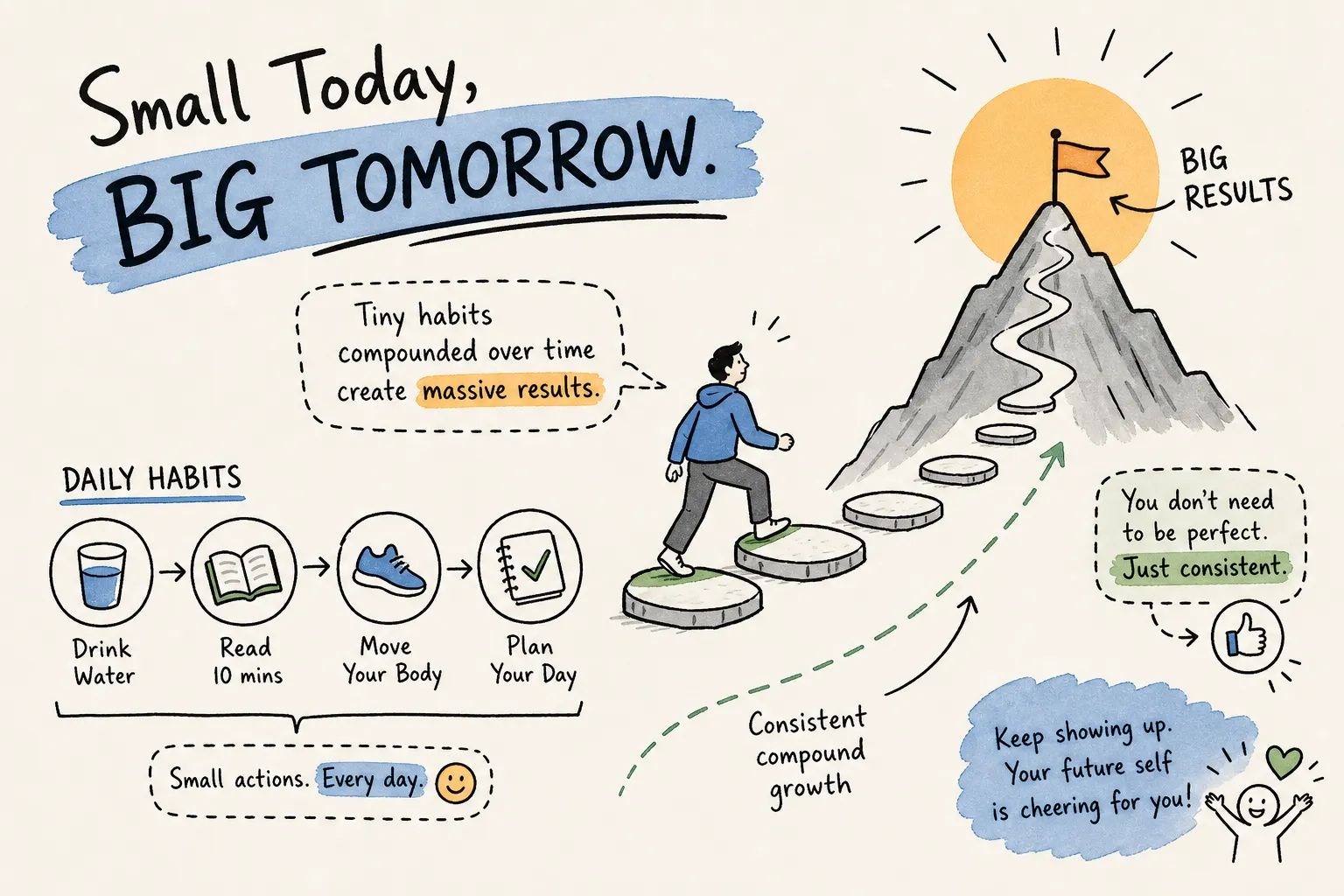
Most people don’t fail at daily habits because they lack discipline. They fail because they start with the wrong model: the idea that success requires a dramatic overhaul, sustained willpower, and perfect execution. Research tells a completely different story. The real driver of lasting change is how you design your environment and understand what your brain actually needs to automate a new behavior.
That’s what this article is about. At Qurabox, we cover practical wellness and self-improvement across every area of life, and habit formation sits at the center of almost every goal readers bring to us, whether that’s better energy, sharper focus, or less daily stress. What follows is the research-backed framework: why habits form, which ones deliver the highest return, and a realistic 30-day plan to make them stick.
Why your brain is wired for habits (and resists new ones)
How the habit loop actually works
Your brain runs on efficiency. Every time you repeat a behavior in a consistent context, your brain encodes it as a three-part loop: a cue triggers a routine, and the routine delivers a reward. Neurologist Charles Duhigg popularized this framework, but the underlying biology is well-documented. Your basal ganglia, the region responsible for procedural memory and habit formation, gradually offloads repeated behaviors from your conscious prefrontal cortex so you can execute them without deliberate thought. That’s why your morning coffee ritual feels effortless while a brand-new habit feels exhausting. The brain hasn’t automated it yet.
This is not a character flaw. Resistance to new habits is biology, not weakness. The friction you feel when starting something new is simply the cost of building a new neural pathway.
The 21-day myth and what research actually shows
You’ve probably heard that habits take 21 days to form. That number has no scientific basis. A 2009 study by Phillippa Lally and colleagues at University College London found the actual average is 66 days, with a range of 18 to 254 days depending on the person and the complexity of the behavior. A 2024 meta-analysis reinforced this finding, concluding that most health-related habits require two to five months before they reach true automaticity.
The reassuring part: missing a day doesn’t derail your progress. Lally’s data suggest occasional missed days do not fully negate habit formation, what matters is the overall pattern of repetition, not a perfect streak. Occasional slip-ups had minimal impact on long-term outcomes in her research. Consistency over time outweighs any single missed day. For a practical overview of timelines and how they vary by habit, see this article on how long it takes to form a habit (how long it takes to form a habit).
The compound effect: why small daily practices beat big change
The math behind marginal gains
The math here is worth understanding once, because it reframes how you think about progress. If you improve by just 1% each day for a year, you end up 37.78 times better than when you started, that’s 1.01 raised to the power of 365. This is a mathematical illustration, not a literal performance metric, and it’s worth treating it as such. What it models well is why consistency beats intensity: a small action repeated daily for months accumulates into something unrecognizable compared to where you started.
The failure pattern for most people runs in the opposite direction: the all-or-nothing approach. Commit to a huge change, sustain it for two weeks on motivation, then collapse when life gets complicated. Studies on habit formation consistently find that smaller, lower-friction behaviors survive precisely because they don’t depend on motivation to execute.
Why big resolutions collapse and small habits survive
Behavioral research on “implementation intentions” shows that the more specific and low-effort a habit is, the more likely it is to stick. Vague goals like “get fit” collapse under ambiguity. Specific plans like “I will walk for 20 minutes after lunch on weekdays” create a clear cue, a defined action, and a predictable context. The everyday habits covered in the next section are chosen precisely because they are low in friction and well-supported by evidence, each one is backed by the research cited throughout this guide.
The highest-impact daily habits, grouped by what you want
Daily habits for physical health and energy
The evidence here is unusually consistent across decades of research. Regular movement tops every list: the U.S. Physical Activity Guidelines recommend 150 minutes per week of moderate-intensity aerobic activity plus muscle-strengthening work at least twice a week. Sleep consistency deserves equal attention. UCLA research links sleep consistency, specifically going to bed and waking at the same time daily, to a significantly lower risk of depression and anxiety compared to irregular sleepers.
Diet quality is the third pillar: prioritizing minimally processed, plant-forward foods is associated with better cardiometabolic health and longer life, findings supported by large cohort studies including the Nurses’ Health Study and the PREDIMED trial. Hydration rounds out the baseline. Many people start the day mildly dehydrated after seven to eight hours without fluids, and some research suggests morning rehydration can support alertness, making it a low-barrier habit worth building in early.
Daily habits for mental clarity and stress relief
A study of 1.2 million U.S. adults found that people who exercised regularly reported 1.49 fewer poor mental health days per month compared to those who didn’t, a reduction of roughly 43% that held across all exercise types. Beyond movement, five to fifteen minutes of mindfulness, controlled breathing, or journaling functions as a daily stress anchor, giving the nervous system a predictable window to downregulate. Predictable daily routines are also linked to lower anxiety and reduced mental fatigue, a pattern documented across multiple behavioral health studies on decision fatigue and allostatic load. Structure reduces the cognitive load of decision-making, and that reduction compounds over a full week.
Daily habits for focus and productivity, and daily rituals for productivity that compound
Three small habits consistently show up in productivity research. A single daily planning moment, just five minutes each morning to identify your top priorities before anything else competes for attention, anchors the day. A protected first 30 minutes, free from screens and notifications, lets your focus start on your own agenda instead of someone else’s. A brief end-of-day review closes mental loops before sleep. Unfinished mental tasks create what psychologists call the Zeigarnik effect, where open loops continue consuming cognitive resources. A short review closes them and makes the next morning easier.
How to build a morning and evening routine that actually holds
A 10-minute morning setup for the rest of your day
The most effective morning routines aren’t elaborate. They’re short, sequenced, and done before your phone gets involved. Start with water immediately after waking: you’ve been fasting for seven to eight hours, and starting hydrated supports cognitive function from the outset. Follow with three to five minutes of light movement or stretching, brief exercise increases blood flow and has been shown to improve alertness and energy independent of caffeine. Then write down your three most important tasks for the day. That’s the full sequence. Avoid checking email or social media until after this is done. Research on “attention residue” is clear: opening your inbox before you’ve set your own priorities fragments your focus for hours.
A 5-minute evening wind-down that prepares tomorrow
The evening routine exists to serve the morning, not just sleep. A brief daily review, one thing that went well and one adjustment to make tomorrow, takes about two minutes and builds self-awareness over time. Laying out tomorrow’s essentials the night before (clothes, bag, workspace) removes morning friction at the moment when your decision-making energy is lowest. A consistent bedtime signal, whether that’s reading, breathing exercises, or light stretching, trains your nervous system to shift into sleep mode on schedule. The result is faster sleep onset, better sleep quality, and a morning that starts with context already set.
Making daily habits stick: stacking, environment, and tracking
Habit stacking and environment design
Habit stacking is one of the most reliable adherence strategies in behavioral research. The formula is simple: “After [existing habit], I will [new habit].” For example, “After I pour my morning coffee, I will write my three priorities for the day.” Or: “After I sit down at my desk, I will put my phone face-down for the first 30 minutes.” The existing habit acts as a reliable trigger, so the new behavior inherits an already-established cue without needing a separate reminder.
Environment design works in parallel. Leaving your running shoes visible by the door removes the decision barrier for a morning walk. Putting a book on the pillow makes reading before bed the path of least resistance. Research on behavior change also suggests that self-compassion after slip-ups, not rigid discipline, is a stronger predictor of long-term adherence. Studies on flexible versus perfectionistic approaches to habit maintenance consistently find that people who treat missed days as normal setbacks, rather than reasons to quit, sustain their routines far longer. For practical tips on building confidence and reducing self-doubt, see our guide on How to Be Confident Fast (Proven Tips), Boost Self-Esteem & Beat Self-Doubt Today.
Everyday habits and the tools that help you track them
If you prefer a digital approach, three apps stand out in 2026 for user ratings and practical features. Streaks (iOS, 4.9/5) integrates directly with Apple Health and tracks habits automatically for supported behaviors. Habitify (cross-platform, 4.8/5) syncs across iOS, Android, Mac, and web with solid analytics and a generous free tier. Finch (4.9/5, more than 10 million downloads) takes a self-care-focused approach that works well for people who find aggressive streak tracking stressful.
The low-tech alternative is a paper streak grid: draw a calendar grid, mark an X for each completed day, and let the visual chain do the motivational work. Pair this with the two-minute rule, scaling any new habit down until it takes less than two minutes to start, and the friction of beginning nearly disappears. The right tool is always the one you’ll actually use.
Your 30-day starter plan to lock in 3, 5 habits
How to choose your 3, 5 habits by goal
Start by picking a single primary goal: physical health, mental wellness, or focus and productivity. Then choose two to three habits from the section above that directly serve that goal. Specificity is non-negotiable here. “Exercise more” is not a plan. “Walk for 20 minutes after lunch on weekdays” is a plan with a cue, a duration, and a context. Start with the lowest-friction options and add complexity only after the baseline feels close to automatic. Trying to overhaul five areas of life simultaneously is the most reliable way to make progress in none of them.
Week-by-week progression for the first 30 days
In weeks one and two, focus on a single habit. Establish the cue, execute in a consistent context, and don’t add anything else yet. The goal is repetition, not volume. In weeks three and four, add a second habit using stacking so it anchors to the first. By day 30, run a short checkpoint: which habit feels close to automatic, which one still needs support, and what one adjustment would make the next 30 days stronger.
Keep in mind that true automaticity typically takes longer than 30 days, Lally’s 2009 research puts the average at 66 days, and the 2024 meta-analysis suggests most health-related habits need two to five months to fully solidify. Two weeks of consistent repetition builds the foundation; the goal of this plan is to establish the pattern, not complete the process.
If you want to go deeper on any specific area, Qurabox publishes step-by-step guides on How to Build Good Habits That Stick: 6 Science-Backed Steps, sleep optimization, fitness for beginners, stress management, and productivity systems. Every guide is built for the same reader this article is written for: someone practical who wants real information, not motivation-poster advice.
Start small, stay consistent
The research makes the conclusion clear: daily habits work not because of willpower but because of repetition, design, and time. The 66-day average, the compounding model, the habit loop, all of it points to the same strategy. Start smaller than you think you need to. Make the environment do as much of the work as possible. Expect imperfection and keep going anyway.
The single most effective move you can make after reading this is to choose one habit, not five. Assign it a specific cue, a specific context, and a specific duration. That’s the whole plan. It’s less exciting than a complete lifestyle overhaul, and that’s exactly why it works, low friction, consistent repetition, and time are the actual ingredients.
When you’re ready to build from that foundation, Qurabox covers every area where healthy routines matter: home, fitness, sleep, mental wellness, and everyday life. Download our free 30-day habit checklist and start your first habit today. You don’t need a perfect system, you need a first step and a place to come back to. For guidance on healthy habits specifically targeted toward midlife longevity, see this Stanford piece on healthy habits for people in their 40s and 50s (healthy habits for longevity).
Frequently asked questions about daily habits
How long does it actually take to form a daily habit?
Research by Phillippa Lally and colleagues found the average is 66 days, with a range of 18 to 254 days depending on the person and behavior. A 2024 meta-analysis confirmed that most health-related habits take two to five months to reach true automaticity. The popular “21 days” figure has no scientific basis.
What is habit stacking and does it work?
Habit stacking links a new behavior to an existing one using the formula: “After [current habit], I will [new habit].” Because the existing habit already has a reliable cue, the new behavior inherits it without needing a separate reminder. It’s one of the most well-supported adherence strategies in behavioral research.
What are the best apps for tracking daily habits in 2026?
Streaks (iOS, 4.9/5) integrates with Apple Health for automatic tracking. Habitify (cross-platform, 4.8/5) offers strong analytics across iOS, Android, Mac, and web. Finch (4.9/5, more than 10 million downloads) suits users who prefer a lower-pressure, self-care-oriented approach. A simple paper streak grid works just as well if you prefer analog.
Does missing a day ruin a habit you’re building?
No. Lally’s research indicates that occasional missed days have minimal impact on long-term habit formation. Consistency over time matters far more than a perfect streak. Treating a slip as a signal to quit is the real risk, not the missed day itself.
What is the best way to start building daily habits from scratch?
Pick one habit, not five. Make it as specific as possible, define the cue, the action, and the context. Use habit stacking to attach it to something you already do reliably. Remove environmental friction wherever you can. Then repeat it for at least 30 days before adding anything new.