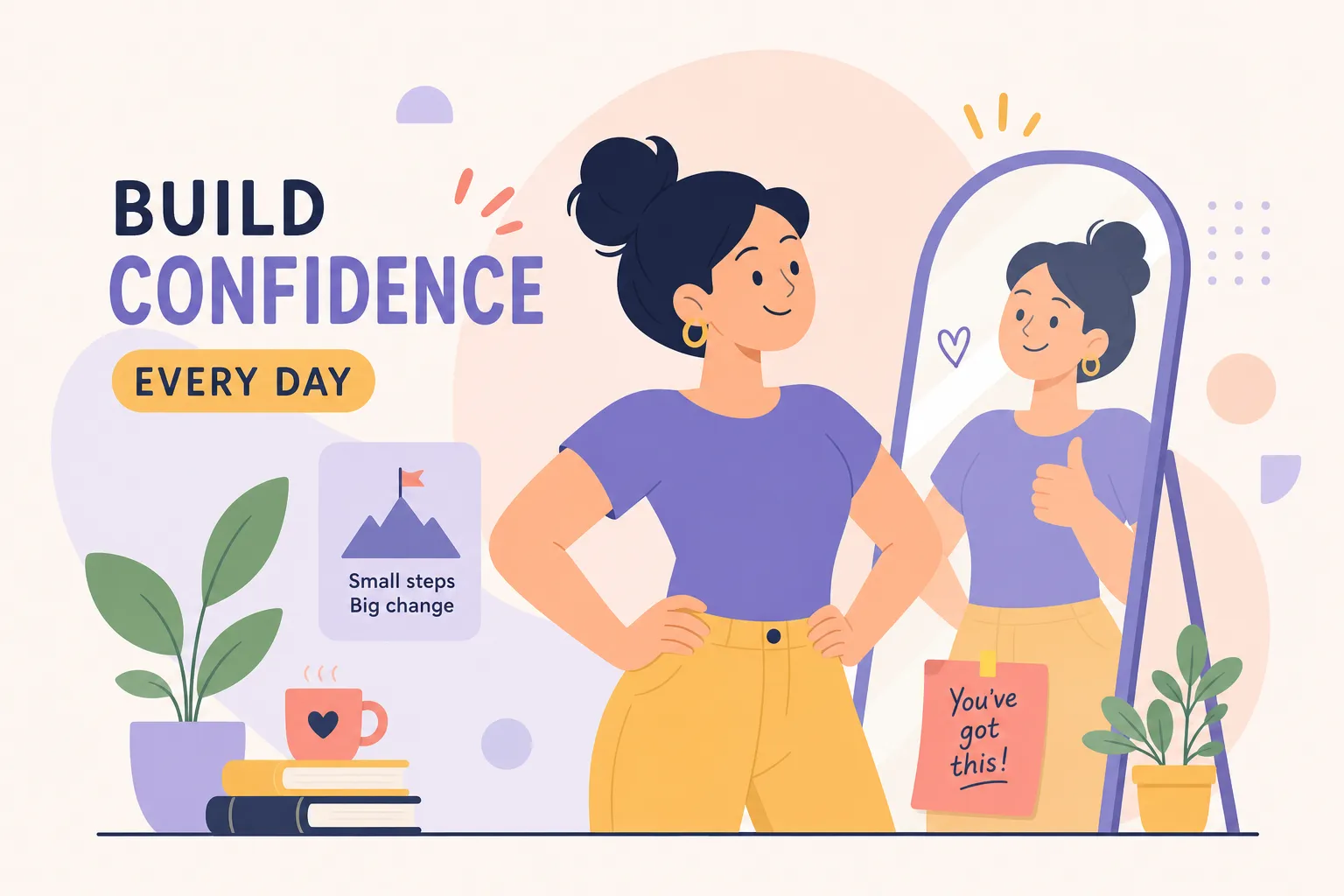
A common belief holds that confidence is something you either have or you don’t. You walk into a room and you’ve either got it, or you spend the next hour hoping nobody calls on you. That belief is the first thing worth throwing out. Confidence is a skill, and you can build confidence through repetition, experience, and doing, one situation at a time. It is not a personality trait handed out at birth.
At Qurabox, we cover everything from home maintenance to personal wellness, and the question we hear most often in some form is: “How do I actually become more confident?” Not faking it. Not reciting affirmations in a mirror. Actually building the kind of self-assurance that holds up when things get uncomfortable. This guide answers that question directly, with evidence-backed strategies and a 30-day action plan you can start today.
Before you can build something, you need to know what you’re actually building. That distinction is worth covering before anything else.
Confidence vs. Self-Esteem: Why the Distinction Changes Everything
What Confidence Really Is (and Isn’t)
Confidence is task-specific. It is your belief in your ability to handle a particular challenge or situation, and it grows through doing. Someone can be completely at ease presenting quarterly results to a boardroom and fall apart on a first date. That’s not inconsistency; that’s exactly how confidence works. It is not a general “boldness” you’re born with or without. It is something you develop in specific domains through specific experiences.
The misconception that confident people feel confident about everything is one of the most discouraging myths around. When you understand that confidence is situational, you stop waiting for a personality overhaul and start focusing on the one skill or situation where you want to grow first.
How Self-Esteem Fits Into the Picture
Self-esteem operates at a deeper level. It’s your overall sense of self-worth, how much you value yourself as a person independent of any specific performance. The Rosenberg Self-Esteem Scale, the most widely used validated tool for measuring this, scores adults on a range of 0 to 30, with population research placing most adults between 15 and 25, and the average falling around 22. That means most people start with meaningful room to grow in both directions.
Improving self-esteem is slower, deeper work than building situational confidence. The good news is that you don’t need to resolve every self-worth question before your confidence in specific areas starts moving. This distinction tells you exactly where to begin: pick a domain, take action, and let the wins accumulate.
How to Build Confidence: What’s Actually Causing Low Self-Assurance
The Real Psychological Roots of Self-Doubt
Low confidence rarely comes from nowhere. The most common roots are chronic childhood criticism, bullying, trauma, perfectionism, and patterns of negative self-talk that developed as a coping mechanism at some point and never got updated. Depression and anxiety frequently overlap with low self-esteem, which makes confidence feel even further out of reach during difficult periods. If any of these resonate, that’s worth noting without judgment.
Low confidence is not a character flaw. It is almost always a learned pattern, developed in response to real experiences. Understanding that reframes the whole project: you’re not fixing something broken in you, you’re updating a pattern that no longer serves you.
How Self-Doubt Becomes a Reinforcing Loop
Here’s the cycle that keeps people stuck: self-doubt leads to avoidance, avoidance prevents new experiences, and the lack of new experience reinforces the original belief that you can’t do it. The loop is self-sealing, which is why positive thinking alone rarely produces lasting change. Telling yourself you’re capable doesn’t override a nervous system that has never experienced you being capable in that specific situation.
For most people, the most direct route out of this loop is behavioral. You have to do the thing, even imperfectly, to generate the evidence your brain actually needs. Research on behavioral activation and graded exposure, core components of CBT, consistently supports this as the primary mechanism of change. Every strategy in the next three sections is designed to interrupt this cycle at the action level, not just the thought level.
How to Build Confidence: Mindset Shifts That Move the Needle
Challenging the Inner Critic With CBT
Cognitive behavioral techniques give you a repeatable process for working with self-critical thoughts without being swept away by them. The three steps are: notice the self-critical thought, question whether it holds up against actual evidence, and replace it with a more accurate alternative. That last step matters because you’re not looking for false positivity; you’re looking for accuracy. Turning “I’m terrible at speaking up in meetings” into “I haven’t practiced speaking up much yet, and that’s changeable” is more honest and far more useful.
A 2021 meta-analysis published in Clinical Psychology Review found CBT-based interventions to be among the most effective approaches for improving self-esteem in adults, with effect sizes ranging from moderate in workshop formats to large in weekly structured sessions, evidence you can review directly in the 2021 meta-analysis in Clinical Psychology Review. A separate clinical study reported that 89% of participants showed reliable improvement in self-esteem immediately after CBT treatment, with 83% maintaining gains at follow-up. These techniques aren’t therapy homework reserved for clinical settings, they’re mental habits anyone can build with practice. That said, if you’re dealing with severe or clinical-level low self-esteem, depression, or trauma, working with a licensed therapist offers meaningful advantages over self-guided approaches alone.
Dropping Perfectionism Before It Drops You
Perfectionism feels like high standards, but it functions as a confidence killer. When the internal rule is “I have to get this right,” any imperfect outcome reads as failure, which feeds self-doubt rather than building capability. The shift worth practicing is from “I have to get this right” to “I’m going to get better at this.” That single reframe keeps the door open for growth instead of slamming it shut at the first mistake.
Self-compassion is not softness. Research consistently supports responding to your own mistakes with the same basic kindness you’d offer a friend going through the same thing. Harsh self-criticism after failure doesn’t improve performance; it just makes the avoidance loop tighter.
Reframing Setbacks as Data, Not Verdicts
A setback tells you where to practice next. It doesn’t tell you who you are or what your ceiling is. This reframe, often associated with growth mindset research, is practical rather than motivational: when you treat a failure as information, you can act on it. When you treat it as a verdict, you can only feel bad about it. Keep this one simple, and apply it throughout the 30-day plan below.
Daily Habits to Build Confidence That Actually Compound
A Five-Habit Daily Routine (Under 20 Minutes)
The goal here is a stackable daily routine, not a menu of options to pick from when you feel like it. Consistency beats intensity every time when it comes to building confidence. The five habits are:
- Complete one tiny, defined goal before noon. Writing one email, tidying one surface, finishing one task. Small completions generate mastery experiences, which Bandura’s foundational research on self-efficacy theory identifies as the primary driver of growing belief in your own ability.
- Do 10 to 15 minutes of physical movement. A brisk walk counts. A 2023 review in Mental Health and Physical Activity found that even short bouts of daily exercise are reliably associated with improved body image and self-assurance, and the bar is intentionally low so there’s no excuse to skip it, see the 2023 review on exercise and mental health for more.
- Take one growth-zone action. Something slightly uncomfortable but manageable: asking a question in a meeting, making a call you’ve been putting off, trying one thing you’re not yet good at.
- Write down three small wins at the end of the day. Not major achievements. Small ones. This directly counters the tendency to discount progress and reinforces the evidence your brain needs to update its model of what you’re capable of.
- Use one minute of slow breathing as a daily reset. A simple pattern, inhale for two counts, hold briefly, exhale for four, supports self-regulation and reduces the baseline anxiety that makes confidence harder to access. Breathing-based resets of one to three minutes have a consistent track record in the mindfulness and anxiety literature for lowering physiological arousal.
Why Small Wins Compound (and How to Stop Discounting Them)
The most common trap in confidence building is dismissing small wins as irrelevant. “That was easy, it doesn’t count.” This thinking is exactly backward. According to self-efficacy theory, repeated successful experiences are the primary mechanism through which confidence actually builds. Your brain updates its model of what you’re capable of through accumulated evidence, not through affirmations or pep talks.
Consistency over intensity is the core principle here. Five minutes of daily practice produces more lasting change than one big confidence-boosting event every few weeks. The routine above is designed to be achievable on a bad day, which is precisely when showing up matters most.
Your 30-Day Plan to Develop Lasting Confidence
Weeks 1 and 2: Building the Foundation
For the first two weeks, the only job is running the five-habit routine consistently. No pressure to push hard outside your comfort zone. The priority is showing up every day and noticing small wins. Add one sentence of journaling each day: what you did, and how it felt. This isn’t a diary; it’s a progress log that will matter more in week four than it does right now.
Expect this to feel unremarkable at first. That’s normal, and it’s not a sign that it isn’t working. The compound effect of mastery experiences takes time to register, but the foundation is being built whether you feel it yet or not.
Weeks 3 and 4: Expanding the Comfort Zone
In the second half of the month, the growth-zone action gets incrementally bigger. Start introducing assertiveness practice using “I think,” “I feel,” and “I want” framing in everyday conversations. If you want a more structured tool, the DESC script (Describe, Express, Specify, Consequences/Outcomes) gives you a repeatable framework for expressing a need or boundary without it feeling like a confrontation, the “Consequences” step refers to positive outcomes, not threats. Practice it written out first, then use it in a low-stakes conversation.
The goal for weeks three and four is one slightly more challenging social or professional action per week. Not a dramatic leap; a deliberate step. Each step generates new evidence, and that evidence is what your confidence is built on.
Tracking Progress and Handling Setbacks Without Losing Momentum
Self-assessment doesn’t need to be complicated. A simple weekly rating of 1 to 10 for how confident you felt in your target area is enough to track a trend over a month. You’re looking for a general upward direction, not a perfect score. A hard week doesn’t reset 30 days of consistent work; confidence building is cumulative, and a setback is data, not a verdict.
If you want to go deeper on habit tracking after the 30 days, Qurabox has additional guides on building daily habits that actually stick and sustainable wellness routines that pair well with the work you’ll have started here. The 30-day plan is a starting point, not a finish line, for a focused guide on moving faster with confidence, see our article on How to Be Confident Fast.
Start Today, Not Monday
Building confidence isn’t a personality transplant. It’s a process built on mindset shifts that make room for growth, daily habits that generate real mastery experiences, and consistent small wins that stack into something durable. The Rosenberg scale shows most adults start in the middle range of self-esteem, which means almost everyone reading this has meaningful room to grow.
The research is clear on what works: CBT-style thought challenging, small daily goals, repeated behavioral practice, and self-compassion after mistakes. None of it is complicated. It just requires consistency. Pick one habit from the daily routine above and do it before today ends. Not tomorrow, not Monday. Today. That’s how the first win gets logged, and that’s how you begin to build confidence in practice.
For ongoing support, explore Qurabox’s guides on building daily habits that actually stick. Not to feel confident someday, but to collect enough evidence that confidence becomes the natural result.