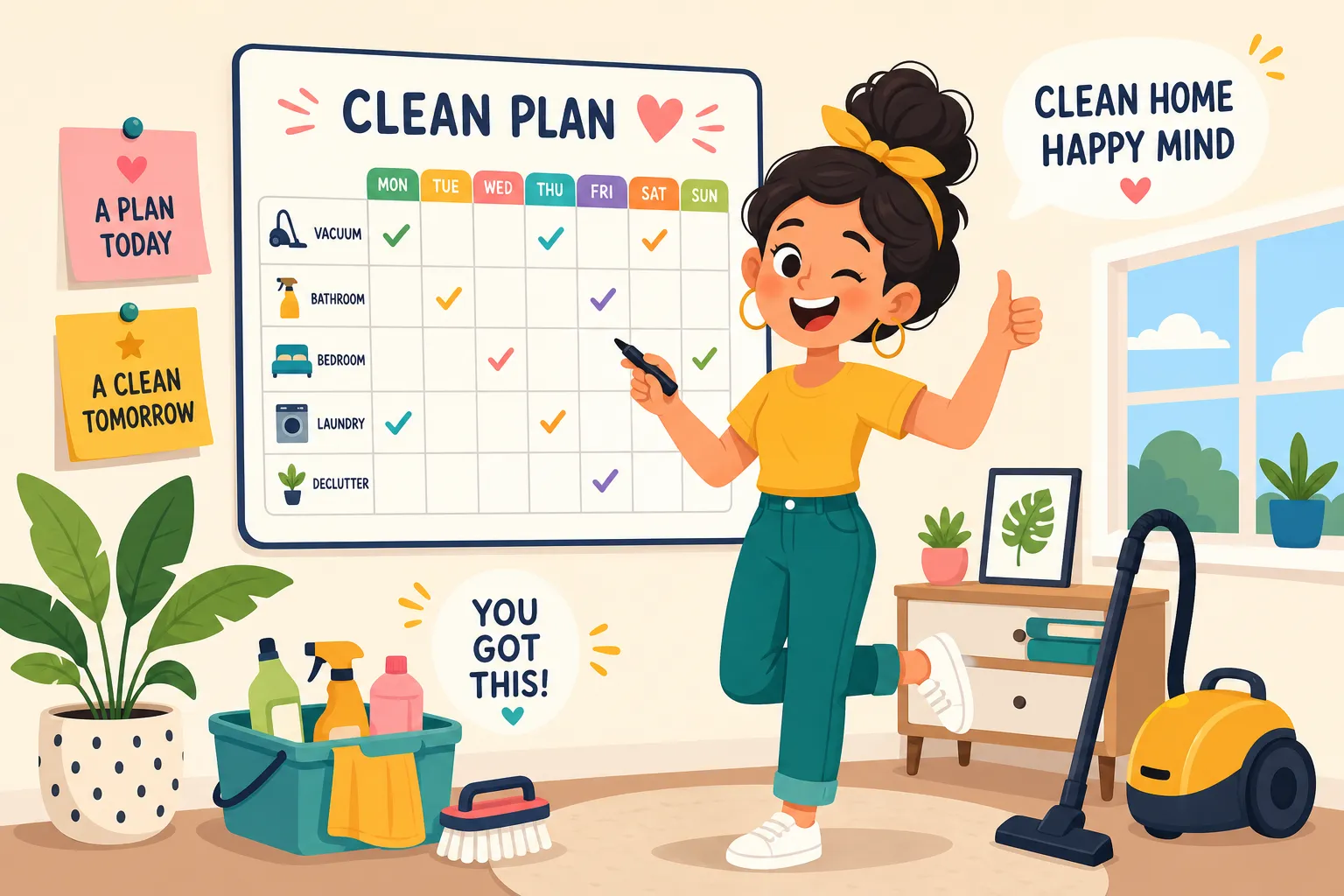
If you’ve ever asked yourself, how do I create a cleaning schedule that I will actually stick to, you’re not alone, and the answer almost certainly isn’t “more willpower.” You made a cleaning plan, followed it for four days, and then it disappeared into a drawer never to be seen again. The problem isn’t that you lack discipline or don’t care about a clean home. The problem is that most cleaning schedules are designed for an idealized version of your life, not the one you’re actually living.
This guide gives you a practical, psychology-backed system for building a cleaning routine that fits around your real schedule. You’ll get a realistic breakdown of daily, weekly, and monthly tasks, specific habit triggers that make chores feel automatic, and a built-in fail-safe for when life inevitably gets in the way. No Pinterest-perfect fantasy here, just a chore schedule that actually works.
Why most cleaning schedules fall apart so fast
The perfectionism trap that kills routines before week two
Many people abandon a new cleaning routine after a single missed task, not because they’re lazy, but because of a well-documented behavioral pattern called the “what the hell” effect. The cycle works like this: one task gets skipped, the whole schedule feels broken, and the mental response is essentially “well, I already messed up, so what’s the point.” Behavioral research on lapse-triggered relapse confirms this pattern: a missed task triggers guilt, guilt reduces self-efficacy, and the rationalization to keep skipping follows naturally.
The issue isn’t motivation. It’s that the schedule was built with zero tolerance for real life. When your cleaning plan assumes you’ll always have energy, time, and the will to wipe down bathroom tiles on a Tuesday night, it will fail. The fix starts with designing a plan that expects disruption rather than hoping to avoid it.
Starting too big and expecting too much
The most common mistake is building a brand-new cleaning plan that covers every room, every surface, and every day of the week. By day three, the list feels longer than your actual life and gets abandoned entirely. According to American Time Use Survey data, the average American spends about six hours per week on cleaning, but the range varies significantly by household: singles typically need only 1.5 to 3 hours weekly, couples around 2 to 4.5 hours, and families with kids often fall toward the higher end, roughly 3 to 7 or more hours depending on home size.
Building a cleaning schedule without knowing where you land in that range is like packing for a trip without knowing the destination. A realistic cleaning plan starts with your household’s actual demands, not a generic template downloaded from a lifestyle blog.
How do I create a cleaning schedule that I will actually stick to? Start here
Taking stock of what actually needs cleaning
Walk through your home with fresh eyes and note the areas that collect the most mess: high-traffic zones, pet areas, kids’ spaces, and the surfaces you keep meaning to wipe down but never do. The zone method works well here. Break your home into manageable segments, kitchen, bathrooms, living areas, and bedrooms, so that cleaning feels segmented rather than one giant, overwhelming task.
In practice, most people over-clean certain areas out of habit and ignore others entirely. A quick walk-through audit fixes that imbalance before you build anything. You may find your kitchen needs daily attention while the guest room only needs a monthly sweep, and your schedule should reflect that difference directly. A simple house cleaning checklist, organized by zone, makes this audit easy to run and revisit later.
Calculating how much time you realistically have
Look at your actual week: work hours, family commitments, social plans, and the energy level you typically carry into each evening. A cleaning routine can be structured as short daily sessions, using the 5-, 15-, or 60-minute templates in this guide, or as focused weekend blocks if your weekdays are maxed out. Neither approach is better in the abstract; the right one depends entirely on when you actually have energy to spend on it. For realistic estimates of how long common cleaning tasks take, see a useful breakdown of how long it takes to clean a house.
Before you build anything, decide between a daily-task model and a weekend-block model. Trying to combine both without a clear plan usually leads to neither happening consistently.
Building habit triggers into your cleaning routine
Habit stacking: the easiest way to make chores automatic
Habit stacking means attaching a cleaning task to something you already do every single day without thinking about it. The logic is simple: you already have a reliable cue, so you borrow it. Behavioral research on habit formation consistently shows this approach outperforms vague intentions like “I’ll clean on Saturdays” because the cue removes the decision entirely. For practical tips on making healthy habits stick, see 5 ways to make healthy habits stick.
Three examples you can copy immediately: wipe the kitchen counter after you make your morning coffee; run the dishwasher after dinner every night; do a quick bathroom sink swipe after you brush your teeth. None of these take more than two minutes, but done consistently, they prevent the accumulation that turns cleaning into a massive project every time you finally get around to it.
The if-then plan for when routines get disrupted
Write a backup plan before you need one. This technique, which behavioral scientists call implementation intentions, converts a vague intention into a specific action plan for when things go sideways. For your cleaning routine, it sounds like this: “If I miss my Monday bathroom wipe-down, then I do it Tuesday morning before work.” That one mental shift prevents the “well, I already missed it” spiral that kills most cleaning routines.
These same principles apply directly to fitness, sleep, and productivity routines, the habit-stacking and if-then framework transfers across all of them. Qurabox’s habit-building guides walk through exactly that application if you want to take the system further.
What to clean and how often: a realistic task breakdown
Daily non-negotiables (takes under 10 minutes total)
The true daily essentials are short: load or run the dishwasher, wipe kitchen surfaces after cooking, and clear clutter from the main living areas before bed. These three tasks prevent the accumulation that turns a manageable cleaning session into a two-hour recovery project. Think of daily tasks as maintaining a baseline, not achieving perfection.
When daily maintenance slips, everything else on your schedule gets harder. A sink full of dishes makes the kitchen feel chaotic, which makes it easier to skip the weekly deep wipe, which leads to the whole system feeling pointless. The daily layer is the foundation everything else rests on.
Weekly zone rotation that keeps the whole house in order
A day-by-day zone rotation limits each weekday session to a single focused area, preventing any one cleanup from running long. A practical structure looks like this: Monday for a kitchen deep wipe, Tuesday for bathroom surfaces and toilet, Wednesday for vacuuming, Thursday for dusting, Friday for floors, and Saturday as a flex or catch-up day. Standard practice calls for vacuuming weekly, a bathroom deep clean weekly, and bedding changes weekly, frequencies supported by household hygiene guidance. For additional context on the average time people spend cleaning their homes, consider this overview of the average person spends cleaning their home.
The real advantage of zone rotation is time control. No single weekday session should run more than 15 minutes when you’re focused on one zone at a time. That defined scope makes it far easier to actually start, and finish.
Monthly tasks you don’t need to think about weekly
Move the bigger jobs to a monthly calendar so they stop haunting your weekly mental load: baseboards, inside the oven, refrigerator interior, window sills, and a deep scrub of the shower or tub. These tasks matter, but they don’t need weekly attention, and treating them like weekly chores adds unnecessary pressure to your regular routine. For guidance on how often to deep clean your house, consult a specialist resource.
Schedule monthly tasks on the first weekend of each month so they never get quietly forgotten. A printable cleaning schedule posted somewhere visible, or a recurring reminder in an app like Tody or Todoist, means you don’t have to track them mentally at all.
Choosing a time template that actually fits your schedule
The 5-minute daily reset for the truly time-crunched
The 5-minute reset assigns one high-priority zone per day on a rotating weekly basis: Monday for kitchen and living room, Tuesday for bathrooms, Wednesday for the bedroom, and so on. This isn’t about deep cleaning, it’s about maintaining a livable baseline when life is running at full intensity. Singles and couples in smaller spaces will find this template the easiest to sustain consistently.
If your household includes kids or pets, this template will likely need a small buffer. Plan for 7 to 10 minutes on days that overlap with high-mess zones, and build that into the rotation rather than treating overruns as failures.
The 20-minute weekday routine for moderate households
A 20-minute structure splits into two parts: five minutes of daily essentials like dishes and clutter, followed by 15 minutes focused on that day’s zone. This builds on the timer-based approach that productivity and time-management research supports: set a clock and work until it rings, then stop. The timer creates a defined end point, which removes the anxiety of not knowing how long cleaning will actually take. That clarity alone is often enough to make starting feel manageable.
The 60-minute weekend session for busy weekday schedules
The two-block model works well for families or anyone with demanding weekdays who prefers to front-load cleaning on Saturday or Sunday. A morning block of 30 minutes covers making beds, a quick declutter, and unloading the dishwasher. An evening block of 30 minutes handles the kitchen reset, one zone deep clean, and the daily chore focus for that day.
Adding a simple app like Todoist for recurring reminders or Tody for household-specific tracking can make this template nearly automatic after a few weeks of repetition. The goal is to reduce the friction of deciding what to do next so you can just start.
Reset days: the built-in fail-safe that keeps you going
What a reset day is and when to use it
A reset day is a pre-scheduled, no-judgment catch-up window built into your cleaning calendar from day one, not added as punishment after things fall apart. Schedule one every two weeks, typically a Sunday morning or a Saturday after lunch. Knowing a reset is coming removes the panic when a full week gets missed, because the system already accounts for it.
Planning for interruptions is one of the most evidence-aligned strategies for keeping any routine alive long-term. Without a reset built in, one bad week feels like proof the schedule doesn’t work. With a reset built in, one bad week is just part of the plan.
Adjusting the schedule without scrapping it
A cleaning schedule is a living document, not a contract you can breach. Two signals that it’s time to adjust: tasks are consistently getting pushed two or more days, or the schedule is creating more stress than it’s relieving. Either signal means something needs to change, not that you’ve failed.
The goal is a clean-enough home with minimum friction, not a spotless home at maximum personal cost. Adjusting your routine based on what’s actually happening in your life is self-awareness working correctly. The schedule exists to serve you, and changing it to fit your real life is exactly what it’s designed to allow.
How do I create a cleaning schedule that I will actually stick to? Build it around real life
The system that makes a cleaning routine stick comes down to three things: design it around your real schedule and time budget, attach tasks to habit triggers so the decision-making disappears, and plan for recovery from the start so one missed week doesn’t derail everything. None of this requires exceptional discipline. It requires good design.
Pick one template from this guide and run it for at least two weeks before judging the results, that’s enough time to see what’s working and what needs to shift. A printable cleaning schedule or house cleaning checklist (organized by daily, weekly, and monthly tasks) makes a useful companion as you dial in your routine. The same habit-stacking and reset principles that make a cleaning routine work apply to any other routine you want to build: small tasks, reliable cues, and a system built to survive real life. For step-by-step guidance on mattress care, including how to handle bedding changes, see How to Clean a Mattress at Home.