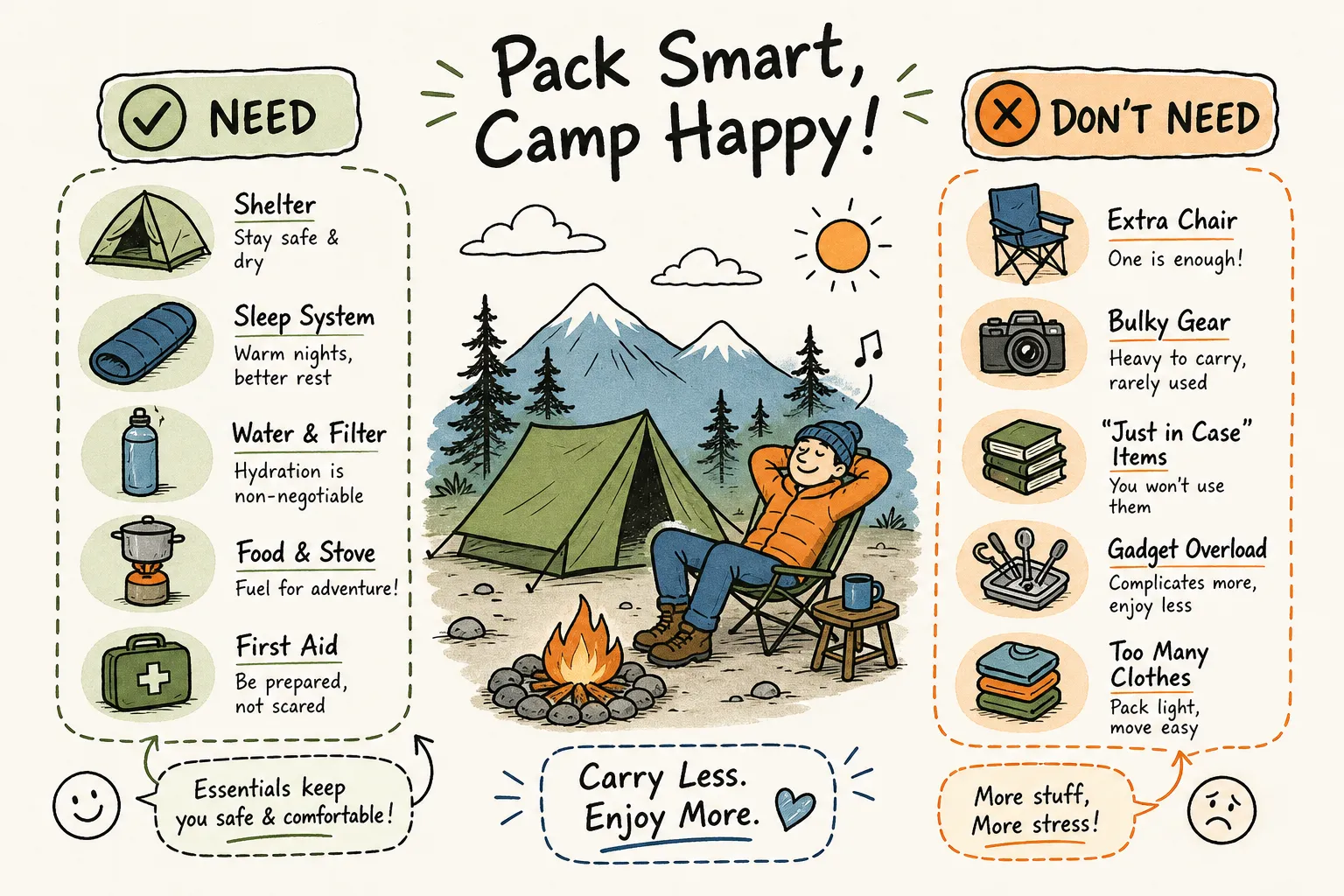
Most first-time campers make one of two mistakes: they show up dangerously under-packed, or they haul a carload of gear they never touch. Neither is a good way to start. There’s no shortage of camping essentials lists online, but most of them don’t separate what keeps you safe and comfortable from what gear companies push on beginners before they know any better. This guide does that job honestly.
Whether you’re planning a weekend car camping trip, a family outing at a state park, or your first backpacking adventure, the core principle stays the same. A solid packing list covers shelter, sleep, food, safety, and lighting, and it tells you what to leave home. That’s the angle this guide takes.
At Qurabox, our beginner outdoor guides are built around one goal: helping first-time campers make confident, practical gear decisions without wasting money. This breakdown covers universal non-negotiables first, then splits into trip-specific needs, so you know exactly what to buy before trip one and what can wait until you actually know what you’ll use.
Camping essentials every camper needs, regardless of trip type
Some items belong in every pack, no exceptions. These aren’t preference items or comfort upgrades, skipping them creates real risk, not just inconvenience. Before you think about trip type or budget, these are the categories you need covered.
The shelter and sleep system: your first priority
A reliable tent, a sleeping bag rated for the expected temperatures, and a sleeping pad form the foundation of any camping packing list worth taking seriously. Most beginners understand the tent and bag. The sleeping pad is where they cut corners, and it’s the worst place to do it.
A sleeping pad insulates you from ground cold more effectively than your sleeping bag does. Without it, body heat drains directly into the earth no matter how good your bag is. A tent footprint is worth adding early as well, it’s a ground sheet that protects the tent floor from abrasion and moisture. It won’t make or break your first trip, but it extends the life of a gear investment you’ll use for years.
Lighting and first aid: the safety layer beginners skip
A headlamp goes in the pack on every trip without negotiation. Your phone flashlight is not a reliable substitute: it drains battery faster than you expect, leaves your hands occupied, and can leave you in the dark at the worst possible moment. Bring a headlamp with a spare set of batteries and keep it accessible, not buried at the bottom of your bag.
First aid is the second item beginners consistently underpack. Your kit should cover the most common problems:
- Adhesive bandages and gauze pads
- Medical tape and antiseptic wipes
- Antibiotic ointment and blister treatment
- Pain reliever and antihistamine
- Tweezers and disposable gloves
- Emergency blanket and whistle
The whistle and emergency blanket feel like overkill until they’re not. For more involved trips, consider adding elastic wraps, burn care supplies, and a CPR mask to round out your kit. Most beginners overpack food and underpack safety, that’s exactly the wrong trade-off when you’re miles from urgent care. For a comprehensive reference on assembling a robust kit, consult the ultimate guide to building a camping first aid kit.
How your trip type changes what you actually pack
Once the non-negotiables are covered, trip type determines everything else. A weekend car camping trip and a two-night backpacking trip share the same base layer of must-have camping gear, but they diverge sharply from there. Applying the wrong camping checklist to your situation is one of the most common beginner mistakes.
Car camping essentials: when weight isn’t your concern
Car camping rewards small comforts. Because you’re driving to the site, you can bring a larger cooler, a two-burner propane stove, camp chairs, a battery-powered lantern, extra blankets, and a folding table without any real penalty. These items genuinely improve the experience when weight and pack size don’t factor in. Overbuying before your first trip is still a financial mistake you don’t need to make, but overpacking for a car camping trip is far less painful than overpacking for backpacking.
Focus your car camping essentials on the non-negotiables plus one or two comfort items you’ll actually use. A good cooler and a solid two-burner stove will serve you better on trip one than a full camp kitchen setup you’re not sure you’ll enjoy yet. If you want a detailed starting point, this car camping essentials checklist is a helpful supplement to this guide.
Family camping checklist: what changes when kids are involved
A family camping checklist follows the same framework but scales up a few key areas. You’ll want extra sleeping pads and bags sized for smaller campers, a larger tent with enough floor space for everyone to sleep comfortably, and additional first aid supplies, particularly blister treatment and antihistamine. A larger water jug and a dedicated wash bin for cleanup keep the cooking routine manageable without adding much bulk. The non-negotiable safety layer matters even more with children in camp, so don’t treat the first aid kit as optional.
For an expanded family-focused list and tips on camping with kids, see REI’s family camping checklist.
Backpacking: the weight-first approach to packing
Backpacking essentials operate under a completely different philosophy. Every item earns its place by weight-to-function ratio. The backpacking kit centers on a 30- to 50-liter pack, a water filter or purifier (not just water bottles), a lightweight shelter, a compact sleeping bag or quilt, and a minimal cook kit. Nothing goes in the pack because it might be useful. Everything in the pack is there because you know you need it.
Here’s a piece of advice that will save you real money: buy your backpacking gear after your first car camping trip, not before. A car camping baseline teaches you what you actually reach for. That real-world experience produces a far better backpacking gear list than anything you’ll find online before you’ve slept outside once.
Camp kitchen camping essentials (what you actually need)
Beginners consistently overestimate how much kitchen equipment a camping trip demands. The gap between what you need to cook a real meal outdoors and what camping catalogs suggest you need is enormous. For a two-night trip, the actual requirement is small.
The real minimum for cooking at camp
The absolute must-have camping supplies for the kitchen are a camp stove with fuel, a lighter or waterproof matches, one pot with a lid, a spatula, a fork and spoon, and a plate or bowl per person. That setup handles breakfast, dinner, and coffee without any issues. A cast iron skillet is often unnecessary for beginners, it’s heavy, takes time to season properly, and adds bulk for no practical gain on a weekend trip.
For a reliable entry-level stove, the Coleman Cascade Classic or a comparable two-burner propane model around $80 handles every weekend trip you’ll take as a beginner. It’s not glamorous, but it works every time.
Food storage demands every campsite has
Food storage is non-negotiable at most US campgrounds, both legally and practically. Proper storage protects wildlife and keeps your campsite free from unwanted visitors overnight. The minimum setup is a hard-sided cooler with ice, resealable bags for dry goods, and bear-proof or odor-proof containers in areas where they’re required. Before you go, check the specific regulations for your campground, national parks and many national forests have strict rules about approved storage methods, and penalties for violations are real. For authoritative guidance on storing food in bear country, review the National Park Service’s bear-safe food storage guidelines.
A large water jug and a wash bin for cleanup round out the kitchen camping supplies without adding significant weight or cost. Dishwashing at camp is simpler than most people expect, and a dedicated bin keeps the process organized.
What you don’t need on your first trip
Being told what not to buy is just as valuable as being told what to buy. The gear categories below get marketed hard to beginners, but none of them justify the cost or the space on trip one.
Comfort upgrades that belong on the trip-two list
A camp pillow is a nice upgrade, but a rolled fleece does the same job on your first night out. A portable camp shower, a hammock, a portable power station, and a full camp kitchen organizer all fall into the same category: legitimate improvements to the experience, but not items you can evaluate accurately before you’ve actually camped. Buy these after a real trip, once you know exactly how you use your time at camp and what genuinely made the experience harder.
Gear that borrows or rents better than it buys
Camp chairs, lanterns, large coolers, and even tents can often be borrowed from friends or family for a first trip. Several outdoor retailers and outfitters offer gear rentals with the big-ticket items covered. Frame this as smart rather than cheap: you’re testing a hobby before committing a few hundred dollars to camping supplies that might sit in a closet after one trip. Gear regret is real, and borrowing for trip one is how you avoid it. If you’re weighing rent-versus-buy choices for specific items, resources on renting camping equipment can help inform which gear is worth owning.
Budget vs. premium: where your money makes a real difference
Not all gear categories carry equal financial risk. Knowing where quality genuinely matters lets you allocate a limited budget where it will actually affect your trip outcome.
Three items worth spending more on
Your sleeping bag and your tent are two places where underspending creates real problems. A cheap sleeping bag that’s misrated for temperature turns a fun weekend into a miserable night. The Coleman Brazos 20, a synthetic 20°F bag under $60, is a reliable budget option that performs honestly at its rating. The Coleman Skydome 4 is a proven entry-level tent that handles standard weekend conditions without issues. Once camping becomes a regular habit, stepping up to a roomier four-season tent makes sense; for trip one, the Skydome is sufficient.
Sleeping pads deserve their own attention. A thin foam pad feels like a saving until your second night on cold ground. Don’t cut corners here, pad quality connects directly to sleep quality, and poor sleep makes everything about the experience worse.
Where budget gear does the job without compromise
Cookware, utensils, coolers, and lighting are all categories where affordable options perform reliably. Headlamps under $30 work fine. A standard hard-sided cooler in the $40 to $60 range keeps food cold for a weekend without any problem. This isn’t about being cheap; it’s about being strategic. Spend your budget on the gear that affects safety and sleep, and save it everywhere else.
A simple system for packing without second-guessing
Knowing what to bring is useful. Having a repeatable filter for every item you consider is better. Before every trip, run each potential item through one straightforward question.
The one-question filter for every item you consider
Ask yourself: “If this item fails or I forget it, does it affect my safety, sleep, or ability to eat?” If the answer is yes, it’s a must-have. If the answer is no, it’s optional on trip one. A headlamp passes: losing your light at night is a safety problem. A camp shower fails: you’ll be fine without it for two nights. Running every item through that filter takes the guesswork out of packing and keeps your load reasonable.
A pre-trip checklist by category
Before you leave, run through five categories: shelter and sleep, safety and first aid, cooking and food storage, clothing and weather protection, and navigation and lighting. These five buckets cover every real need a weekend camping trip presents. Keep a running camping checklist on your phone and add items after each trip based on what you actually used. A personalized gear list built from real experience will outperform any generic camping checklist you find online.
Qurabox’s beginner outdoor guides go deeper on specific gear categories, from choosing the right sleeping bag temperature rating to understanding layering systems for different weather conditions. For example, check out our guide How to Start Surfing for Beginners in 2026 Easy Step-by-Step Guide for another beginner-oriented walkthrough. We also publish non-outdoor beginner guides like How to Build a PC: Beginner’s Step-by-Step Guide (2026 Parts, Budget & Setup) that follow the same step-by-step philosophy.
When you need specific procedural advice, such as building a campfire safely, refer to our step-by-step resource How to Build a Campfire Safely: Step-by-Step Guide for Beginners (Very Easy) to learn safe practices and minimize impacts.
Start simple, build from experience
The goal of your first camping trip isn’t perfect gear. It’s getting outside with what works and learning from the actual experience. Every experienced camper has a story about overpacking, buying something they never used, or realizing too late that one simple item would have made everything easier. That learning process is part of how a good personal gear list gets built.
Stick to these camping essentials on your first trip: shelter, sleep system, headlamp, first aid kit, cooking basics, and food storage. Match the rest of your camping gear list to your specific trip type, car camping, family camping, or backpacking. Resist the urge to buy everything before trip one. The must-have vs. nice-to-have framework applies to every future gear decision you’ll make, not just this one.
After your first trip, you’ll have better questions, a clearer sense of what you actually need, and a much sharper eye for what’s worth buying next. That’s when the real gear list gets built.