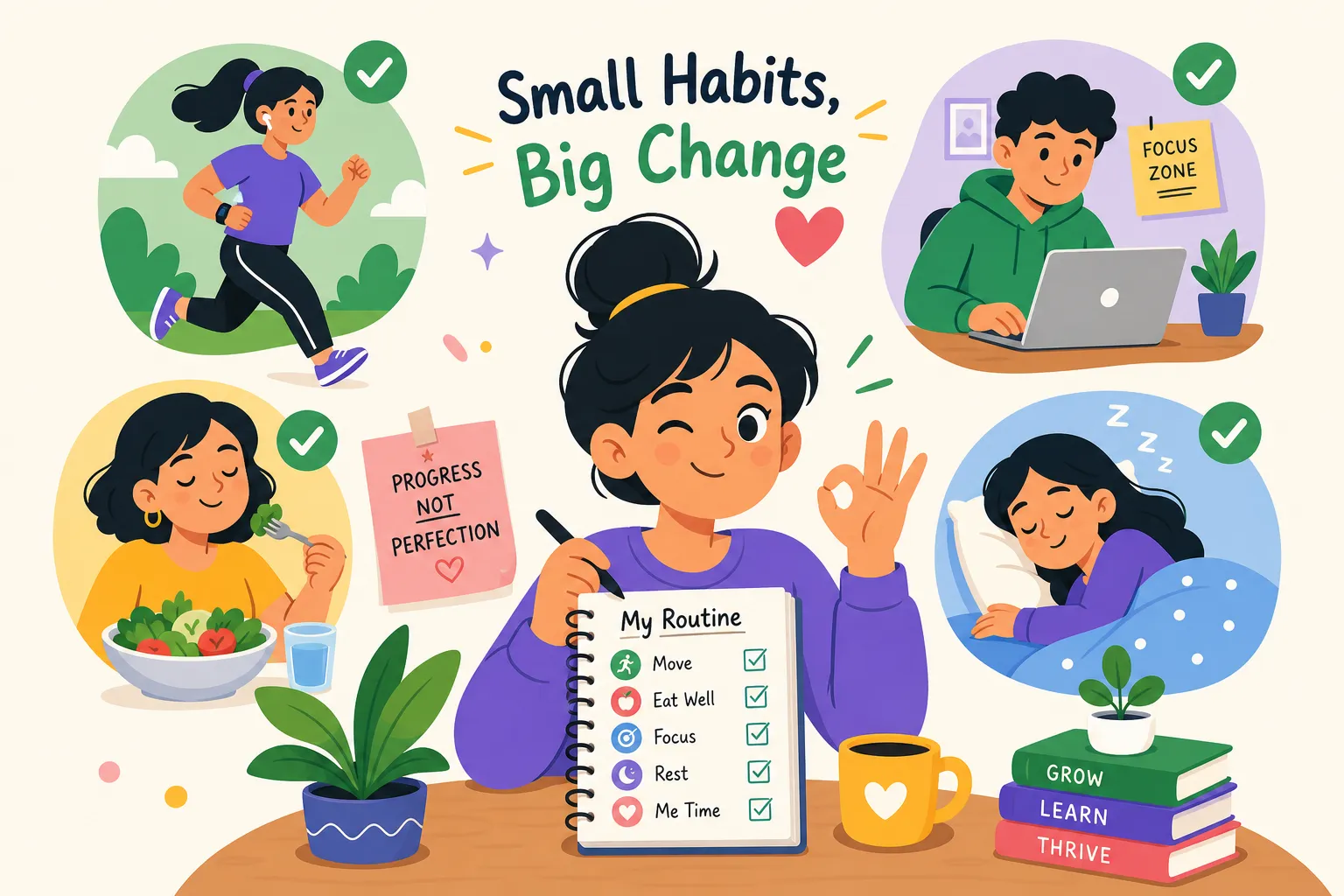
Most people start a new routine with real energy. They wake up early on day one, hit every habit on the list, and feel genuinely good about it. By day ten, the alarm goes off and nothing happens. The temptation is to call it a discipline problem. In reality, design and context are often far more important than willpower, and that shift in framing changes everything about how you build a healthy routine that lasts.
This guide walks you through an evidence-based framework for building a sustainable daily routine from the ground up, organized by time of day with a realistic beginner timeline. You’ll get a sample morning sequence, practical afternoon anchors, an evening wind-down structure, and a clear troubleshooting plan for when life gets in the way. Bookmark this page at Qurabox and come back to it as your routine grows, because what works in month one looks different from what works in month three.
Why Many Daily Routines Collapse Early
When a routine fails, the temptation is to blame yourself. You weren’t motivated enough, disciplined enough, or serious enough. That framing is both inaccurate and counterproductive. The real culprits are poor design, unrealistic expectations, and a widely repeated myth about how habits actually form. Understanding these failure points is the first step toward building healthy habits that hold.
The 21-day habit myth is costing you progress
The idea that any habit becomes automatic in 21 days has no scientific backing. A 2010 study by Phillippa Lally and colleagues at University College London, published in the European Journal of Social Psychology, found the average closer to 66 days, with a realistic range of 18 to 254 days depending on the person and the behavior. A more recent systematic review found average formation times of 106 to 154 days for many health-related habits. Knowing this upfront changes how you interpret the first few weeks entirely. If it still feels hard after two weeks, you’re not failing, you’re still in the very early stage of habit formation.
Starting with too much is the most common design flaw
Most beginner routines are overloaded on day one. Many people try to stack several new behaviors at once, run on novelty-fueled motivation for a few days, and then falter when that initial energy fades. The fix: start with no more than two new behaviors at a time. Habits paired with stable cues and low friction become automatic far faster than ambitious multi-step routines. The goal in the beginning is not to transform your life overnight, it’s to make two specific behaviors feel normal. That restraint is itself one of the most important behavior change techniques you can apply.
How to Build a Healthy Morning Routine That Actually Works
Morning habits are the easiest entry point for most people because they anchor naturally to things you already do every day: waking up, brushing your teeth, making coffee. The morning also sets the tone for how the rest of your day unfolds, which makes it the highest-leverage window for new behavior and a natural place to create a daily routine that sticks.
What the evidence says about strong mornings
Research on habit formation strategies consistently highlights a few behaviors that improve energy, mood, and focus in the morning: at least 10 to 15 minutes of movement, a consistent wake time, and a short planning moment to set the day’s top priorities. For beginners, keep the total time to 20 to 30 minutes. A sample sequence might look like this: wake at 6:30am, drink a glass of water, do a 15-minute walk or stretch by 6:50am, then spend five minutes writing your top three priorities before 7:00am. The specificity matters because vague intentions don’t survive busy mornings.
The movement target isn’t as daunting as it sounds. Public health guidelines recommend 150 minutes of moderate-to-vigorous activity per week, roughly 22 minutes daily. A 10 to 15 minute morning walk covers a substantial portion of that daily-average activity target before the workday even starts. For guidance on the ideal timing and benefits of morning workouts, see this discussion of the ideal time to work out, which explores how exercise timing can fit into a daily routine.
Using habit stacking to lock in your morning habits
Habit stacking uses this formula: “After [existing habit], I will [new habit].” Anchoring new behaviors to reliable cues removes the need to rely on memory or motivation. Three concrete morning stacks: after making coffee, review your three priorities for the day; after brushing your teeth, do five minutes of movement; after pouring your morning water, take any supplements or vitamins you need. These stack onto behaviors you already do without fail, which means the new habit gets pulled along automatically instead of requiring a separate decision each morning. For a practical primer on starting small and stacking habits, consider the new habit guidance that highlights simple anchors and progressive scaling.
Afternoon Habits That Keep Your Energy Steady
The afternoon is where most routines quietly break down. People get busy, skip what they planned, and then write off the rest of the day as a loss. That all-or-nothing thinking is one of the biggest threats to long-term consistency. A simple midday structure, even a short one, prevents that spiral.
The midday reset that prevents a late-day crash
The post-lunch energy dip is real and well-documented. It’s driven by a combination of circadian rhythm patterns and, in many cases, the composition of what you ate at lunch. A short intentional reset can counteract it effectively. A 10-minute walk after lunch, five minutes of intentional breathing, or a quick workspace declutter are all viable options. Breaking your daily movement into smaller chunks throughout the day is just as effective as one longer session, which means a post-lunch walk is a legitimate contribution to your weekly activity total, not just a break.
Simple habit stacks for professionals, parents, and students
The best afternoon stacks are tied to transitions that already happen in your day. For professionals: after finishing a meeting, take five deep breaths and write one action item before opening email. For parents: after the kids leave for school, spend five minutes planning dinner or prepping one meal component so that decision is already made by 5:00pm. For students: after finishing a class or study block, do a two-minute review of what you just covered to reinforce retention before moving on. These examples work because they use existing transitions as anchors rather than carving out entirely new windows of time.
How to Build a Healthy Evening Routine That Sets Tomorrow Up Right
Evening habits are the most neglected part of most people’s daily structure, and they directly determine how well the next morning goes. A short, consistent wind-down routine improves sleep onset, protects sleep quality, and reduces the number of decisions you face when your brain is still half-asleep the next day.
The wind-down sequence that improves sleep quality
Start the wind-down process about 45 minutes before your target bedtime. The core components: reduce screen brightness or shift to low-light activities around 45 minutes out, do a brief body scan or five minutes of stretching in the final 20 minutes, and avoid large meals close to bedtime (within about one to two hours). Consistent sleep timing matters as much as total duration. Adults need at least seven hours per night, but the consistency of when you go to sleep and wake up is what actually stabilizes your sleep-wake rhythm over time. A concrete example: a 10:30pm bedtime paired with a 10:00pm screen cutoff gives your brain 30 minutes to shift into a lower-alert state before sleep. For evidence-based sleep education and tips to improve sleep hygiene, see resources on sleep health and education.
The two-minute prep habit that makes mornings effortless
After brushing your teeth at night, spend two minutes on one of these: lay out tomorrow’s clothes, pack a bag, or write tomorrow’s top priority on a notepad. This single act removes friction from the next morning by reducing the number of decisions you have to make before your brain is fully functional. Decision fatigue is real, research suggests that cognitive resources tend to be lower first thing in the morning, especially when a routine is still fragile and not yet automatic. The evening prep anchor turns a potentially chaotic morning into a far more predictable one.
A Realistic Timeline for Making Healthy Habits Automatic
One of the main reasons routines fail is that people don’t know what to expect at each stage. They start a habit, feel uncertain about whether they’re doing it right, and quit before it has any chance to become automatic. A concrete roadmap, grounded in real habit formation strategies, fixes that.
Weeks 1 to 4: build the foundation with two habits
In the beginner phase, pick one morning habit and one evening habit. Focus entirely on consistency, not quality. Missing one day is not a problem; missing several days in a row is a warning sign worth addressing. Track consistency visually, even with a simple calendar checkoff, because seeing a streak of completed days creates its own momentum. This phase is about making the behavior feel normal, not about getting it perfect or adding more layers.
Month 2 and beyond: layer in habits as the foundation firms up
Once your first two habits feel close to automatic, which for many people happens somewhere between weeks 6 and 10, though individual timelines vary widely, add one new habit at a time and tie it to an anchor you’ve already established. A sample growth path: weeks 1 to 4 focus on a morning walk plus an evening prep ritual; month 2 adds a short morning planning session; month 3 adds a midday reset. Research places the average habit formation timeline at around 66 days, and some health-related habits take considerably longer, so resist the urge to accelerate. Adding too much too early is the same design flaw that derailed the original routine in the first place. The measure of readiness isn’t the calendar, it’s whether the existing habit is running on autopilot. For a recent review of habit formation timelines and related evidence, consult this habit formation systematic review.
What to Do When Your Routine Breaks Down
Every routine breaks down at some point. Travel, illness, a brutal work week, or a rough personal stretch will disrupt even the best-designed system. The goal isn’t to avoid that disruption, it’s to recover from it without letting a lapse turn into a full collapse.
The most common relapse triggers and how to handle each one
Four barriers show up most often, and each has a targeted response.
Stress and overload: Reduce the routine to its two-habit minimum instead of abandoning it entirely. Keeping even a stripped-down version running preserves the cue-behavior connection.
Guilt after a missed day: Treat it as data, not failure. Identify what caused the gap and pick up the next day without self-punishment.
Boredom or fading motivation: Add one small variation to the habit rather than scrapping it. Change your walk route, swap your morning reading topic, or adjust the timing slightly.
Overconfidence: Keep the cue-behavior-reward loop in place even when the routine feels easy. The consistency itself is what makes the habit durable long-term, not the feeling that it’s finally automatic.
Simple tracking tools that support consistency without adding friction
The best tracker is the one you’ll actually use, not the most feature-rich option available. For a free digital option, Loop Habit Tracker provides visual charts and streaks without unnecessary complexity. For a polished app that limits you to 12 habits (which prevents overloading), Streaks works well for people who want a clean interface. For anyone who prefers paper, a simple monthly habit calendar with one checkoff per day gives an at-a-glance visual that reinforces momentum without requiring a screen. Pick one and stick with it for at least a month before deciding whether it’s working. If you want to try Loop on Android, you can find the app on the Google Play store: Loop Habit Tracker on Google Play.
How to Build a Healthy Routine That Fits Your Life
Here’s what your first 90 days actually look like in practice: two habits anchored to existing cues, morning and evening covered before you layer in the afternoon, and a realistic expectation that most habits won’t feel truly automatic until the 66-day mark or beyond. A simple tracking method keeps you honest. That’s the whole system.
Every person’s ideal healthy daily routine looks different. This guide is a starting point, not a finished product. As your routine grows and you start adding new layers, the same behavior change techniques apply: keep it anchored, keep it low-friction, and give it enough time to actually work. If you’re new here and want to know more about the team behind these guides, visit our About Us, Qurabox page. Qurabox publishes step-by-step lifestyle guides across every area of daily life, from home maintenance to habit-building, so bookmark this page and return to it as your routine evolves. For other practical, step-by-step how-tos, see our guide How to Start Surfing for Beginners in 2026 Easy Step-by-Step Guide. The first two habits are the hardest. Everything after that gets easier.
If you want to explore more of the site, go to Qurabox for additional resources and guides.