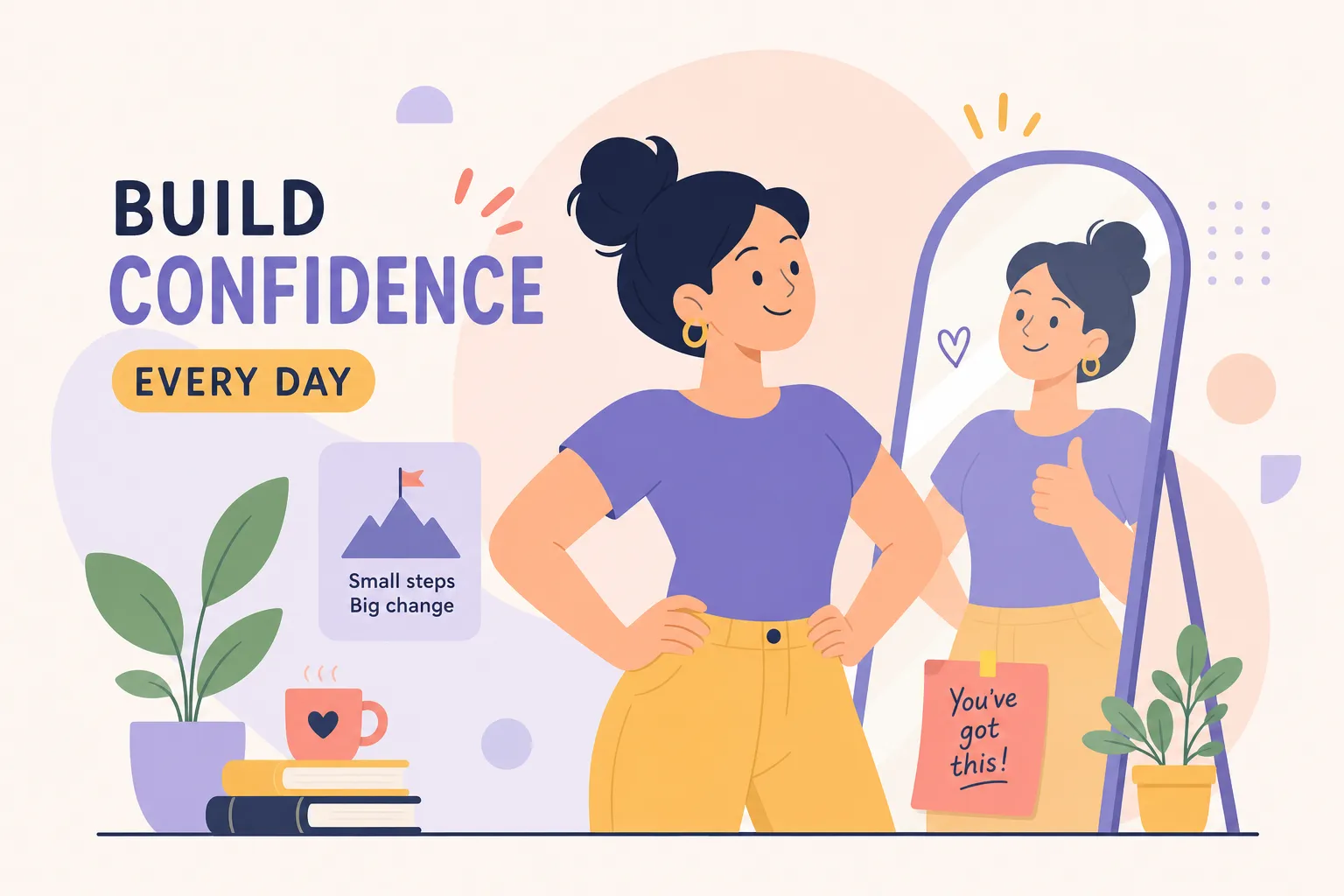
You’ve tried the power poses. You’ve stood in front of mirrors saying positive things to yourself. You’ve watched the motivational videos and felt genuinely fired up for about 45 minutes. Then life resumed, and the old familiar self-doubt came right back, usually louder than before.
That experience isn’t a character flaw. It’s a predictable outcome of relying on surface-level tricks that were never designed to create lasting change. So how do you genuinely build lasting self-confidence in your everyday life? The answer lies in a completely different process: one grounded in identity, repeated small wins, and the kind of honest self-appraisal that gradually rewires how you see yourself. This in-depth guide from Qurabox is built for people who want real answers, not pep talks.
What follows covers nine evidence-backed daily practices with the research behind why they work, a 30-day framework for making them stick, measurable signs of real progress, and guidance on when to escalate beyond self-help. One honest expectation before you read on: change takes weeks, not days. Understanding why the old approach didn’t work is where that change actually begins.
Why Surface-Level Confidence Tricks Don’t Actually Stick
The “Fake It Till You Make It” Problem
Performance-based confidence is fragile because it depends entirely on external conditions. When you get approval, when the presentation goes well, when someone laughs at your joke, the feeling shows up. When those conditions disappear or fail, so does the confidence, and the self-doubt that floods back is usually worse than what you started with. This is the cycle most people recognize: a temporary lift followed by a harder crash, with the inner critic stronger than before.
The core problem is that “fake it” strategies ask you to build confidence on borrowed evidence. You’re performing a state you don’t yet believe in, and your brain knows it. Every time the performance fails, your mind files that away as further proof that the doubt was justified in the first place.
What Actually Drives Lasting Change: The Identity-Habit Loop
The real engine behind lasting self-confidence is what psychologist Albert Bandura called self-efficacy: the belief, built through actual experience, that your effort leads to results. Mastery experiences are the most direct route to self-efficacy. When you do hard things, finish them, and then do slightly harder things, your brain updates its model of who you are and what you’re capable of.
The mechanism runs in the opposite direction from what most people expect. You don’t feel confident and then act. You act consistently, even when uncertain, accumulate small wins, and gradually update your self-image based on that accumulated evidence. This is why the habits in the next section are specific and behavioral, not attitudinal. Changing how you think about yourself starts with changing what you do.
How to Build Lasting Self-Confidence in Everyday Life: Nine Daily Habits
Physical Habits: Your Body Is Where Confidence Starts
The first three habits work at the physiological level, because confidence isn’t purely a mindset, it’s also a body state. Exercising most days, even just 10 to 30 minutes, is the single best-supported habit in the research. A meta-analysis published in Sports Medicine found moderate-to-large self-esteem gains from regular physical activity, with the effect appearing after eight weeks or more and driven not by weight loss but by increased perceived physical competence. Your brain treats physical mastery as direct evidence of capability.
Consistent sleep timing supports everything else on this list. Poor sleep destabilizes emotional regulation, which makes self-critical thoughts louder and harder to challenge. Confidence isn’t something you can think your way into when you’re running on five hours; the physiological foundation has to be there first. A regular wake time, even on weekends, matters more than total sleep hours for emotional stability.
Daily posture and expression resets take 30 seconds and reduce the physical anxiety signals that feed self-doubt. Try this: stand with your feet grounded, shoulders relaxed and slightly back, chin level, and take three slow breaths with your chest open. That’s the entire practice. Done consistently before a challenging moment, it lowers the physical noise that makes doubt louder.
Mental Habits: Rewiring the Inner Critic
Habits four through six work at the cognitive level, targeting the thought patterns that reinforce low self-esteem. Start with one CBT triple-column thought record per day. Write down the automatic negative thought exactly as it came to you, label the cognitive distortion, common ones include all-or-nothing thinking, overgeneralization, and catastrophizing, then write a realistic response based on actual evidence. This is not positive affirmation. It’s accurate appraisal, and the distinction matters because your brain won’t believe something it recognizes as wishful thinking. (For practical self-talk exercises that help train realistic responses, try short daily practices you can follow on a worksheet.)
Five to ten minutes of mindfulness practice each day serves a related but different function. The goal isn’t to feel calm; it’s to create distance between a thought and your belief in it. When you can observe “I’m having the thought that I’ll fail at this” rather than experiencing it as a fact, that thought loses most of its grip. This directly reduces anxiety-driven confidence loss, which is where most people bleed self-assurance without realizing it.
Brief daily journaling rounds out the mental habits. Rotate through prompts like these: “What went well today that I almost dismissed?” or “What am I avoiding, and what would make it 10 percent easier to start?” These prompts direct your attention toward evidence you’re already generating but not registering, a key part of building an honest, positive self-narrative over time.
Behavioral Habits: Actions That Update Your Self-Image
The final three habits are where the real identity work happens, because behavior precedes belief. Set and finish one small daily goal: not a big ambition, but something genuinely completable today. Mastery experiences require completion, not just effort. Finishing a small task builds self-trust in a way that starting a big one and abandoning it never will.
Practice or learn one skill consistently each day. Daily skill growth creates concrete evidence of progress that your brain registers as proof of competence, the raw material of self-efficacy. The skill doesn’t need to be dramatic. Reading ten pages, practicing a language for 15 minutes, working through one problem in a new area: repetition over weeks produces the capability evidence that gradually updates your self-image.
Do one identity-consistent act of self-care every day, not as indulgence but as behavioral reinforcement of the belief “I am someone who takes care of themselves.” Making a real meal instead of skipping it, going for a 20-minute walk, or keeping a consistent bedtime are all valid starting points. Behavior shapes identity, and identity anchors confidence in a way that no amount of positive self-talk ever can.
Your 30-Day Framework for Making These Habits Stick
Days 1, 10: Anchor Your Two Non-Negotiable Habits
Start with just two habits: daily movement and the CBT thought record. Research from Phillippa Lally’s UCL habit formation study (published in the European Journal of Social Psychology) found that habits take an average of 66 days to become automatic, with simpler behaviors forming faster and more demanding ones taking significantly longer. The early phase is about reducing friction, not maximizing effort. Pick a specific, time-boxed slot for each habit; morning routines work best for most people because decision fatigue hasn’t accumulated yet.
Two consistent habits over ten days build more self-trust than nine inconsistent ones, and that self-trust is itself a form of confidence you’re actively building. Stack all nine at once and you’ll likely abandon the whole system by day four.
Days 11, 20: Add a Micro-Challenge and a Progress Log
Introduce one behavioral micro-challenge per week in this phase. Useful examples: initiate one conversation you’d normally avoid, share an opinion you’d usually suppress, or send an email you’ve been putting off. These are deliberate, modest expansions of your comfort zone, and they generate the kind of mastery experiences that no amount of reflection alone can produce.
Start a basic progress log alongside the micro-challenges. Three entries per day: one win, one difficult moment you handled, one action you took despite discomfort. By the end of this phase, you have a written record of evidence that your brain can’t easily dismiss when self-doubt flares up.
Days 21, 30: Review, Adjust, and Raise the Bar Slightly
Use your progress log to identify which habits are producing the most visible behavioral change, then double down on those and let the others run quietly in the background. This final phase is also where you introduce one challenge that felt impossible in week one but now seems within reach. That escalation is what separates genuine confidence-building from comfort-seeking: staying inside a manageable routine indefinitely doesn’t move the needle the way slightly harder challenges do.
How to Know Your Confidence Is Genuinely Growing
Behavioral Signs That Signal Real Change
Genuine confidence doesn’t feel like a permanent emotional high. It feels like steadier ground, and it shows up in behavior before it shows up in feelings. Drawing from Bandura’s self-efficacy research and CBT outcome data, here are the six most credible progress markers to track:
- You act despite discomfort more often than you used to
- Your follow-through on self-set goals has improved
- Tasks that previously felt intimidating are less activating
- Your self-talk is more realistic and less catastrophic
- You recover from setbacks faster
- You’re willing to take on slightly harder challenges without needing external reassurance first
Notice that these are all behavioral markers, not emotional ones. A common mistake is waiting to feel confident before looking for evidence of it. That’s the wrong sequence. The evidence shows up in your actions first, and the feeling follows from it. If you track your progress log honestly, you’ll be able to spot the shift even on days when the inner critic is loud.
A Simple Weekly Self-Check (2 Minutes)
Run through three questions at the end of each week: Did I keep the promises I made to myself this week? Did I do anything that made me uncomfortable but was worth it? Am I attempting slightly harder things than I was seven days ago? A yes to all three is clear progress. A no to one is useful information, not a reason to restart.
Progress is not linear. A week where you had a setback but recovered faster than you would have three weeks ago is still a week of genuine growth, and your log will show you that if you’re tracking it honestly.
When Self-Help Isn’t Enough: Therapy, Coaching, and Clinical Support
Signs It’s Time to Talk to a Professional
Self-directed practice has a real ceiling, and there’s nothing shameful about reaching it. Watch for these specific escalation signals: low confidence is affecting your work performance or relationships, or is causing persistent distress; avoidance behavior is getting worse despite consistent effort; or self-critical thoughts feel compulsive, are linked to shame, or connect to anxiety or trauma that predates these habits. These aren’t signs you’ve failed the process. They’re signs the process needs professional support to go further.
Many people who reach this point have been doing everything right. They’ve simply hit the layer of the problem that self-help tools weren’t designed to address alone, and recognizing that is itself a sign of good judgment.
CBT, ACT, and Coaching: Matching the Tool to the Problem
CBT is the first-line recommendation when the core issue is distorted self-critical thinking, perfectionism, or fear of failure. It’s structured, practical, and has the strongest research base for low self-esteem. A CBT therapist uses thought records, behavioral experiments, and gradual exposure to directly target the patterns keeping your confidence low.
ACT is a better fit when the problem is getting paralyzed by thoughts and feelings rather than inaccurate beliefs. If you already know the self-critical thoughts are exaggerated but still can’t act, ACT focuses on psychological flexibility: accepting that doubt is present, then acting in line with your values anyway. Coaching can supplement therapy for accountability and goal structure, but it is not a substitute when the confidence issue is persistent or clinically significant. Start with a licensed therapist or your GP, then layer in coaching if a specific performance goal warrants it.
Lasting Confidence Is Built, Not Waited For
If you’ve been asking yourself how to genuinely build lasting self-confidence in your everyday life, the answer isn’t a new mindset trick, it’s a new behavioral pattern. Genuine self-assurance is an identity you build through consistent action, honest self-appraisal, and the willingness to act before you feel ready. The nine habits in this guide and the 30-day framework they sit inside won’t make you a fundamentally different person by day 31. But they will instill the behavioral patterns that separate people who feel confident most of the time from those who are still waiting for the feeling to arrive.
The compound effect is the whole game here. Small, repeated actions, honestly tracked and gradually escalated, produce real evidence about who you are and what you’re capable of. That evidence is what the inner critic eventually can’t argue with.
Now pick one habit from the nine, schedule it for tomorrow, and start the log. One decision, made today, is all the 30-day framework requires. When you’re ready for more, Qurabox publishes practical, jargon-free guides on habit-building, wellness, and everyday life, exactly the kind of next step worth having bookmarked.
Frequently Asked Questions
How do I genuinely build lasting self-confidence in my everyday life?
Start with behavior, not mindset. Pick two small daily habits, a short workout and a written thought record, and do them consistently for ten days. Confidence grows from accumulated evidence of follow-through, not from motivation or positive thinking. The 30-day framework in this guide walks you through the full progression. For a concise, focused plan you can try immediately, see How to Be Confident Fast (Proven Tips), Boost Self-Esteem & Beat Self-Doubt Today.
How long does it take to build real, lasting confidence?
Research on habit formation suggests simple behaviors become automatic in roughly four to eight weeks; more complex behavioral patterns take longer. Most people notice meaningful shifts in self-talk and follow-through within three to four weeks of consistent practice, but the compounding effect becomes most visible between weeks six and twelve.
What’s the difference between self-confidence and self-esteem?
Self-confidence is task- and situation-specific: your belief that you can handle a particular challenge. Self-esteem is your broader sense of self-worth. The habits in this guide build both, because repeated competence in specific areas gradually updates the general story you tell yourself about who you are.
When should I seek professional help instead of self-help?
If low confidence is affecting your work, relationships, or daily function, or if avoidance is getting worse despite honest effort, a licensed therapist is the right next step. CBT and ACT both have strong evidence bases for confidence and self-esteem issues. Self-help tools are a solid starting point, but they have a ceiling.