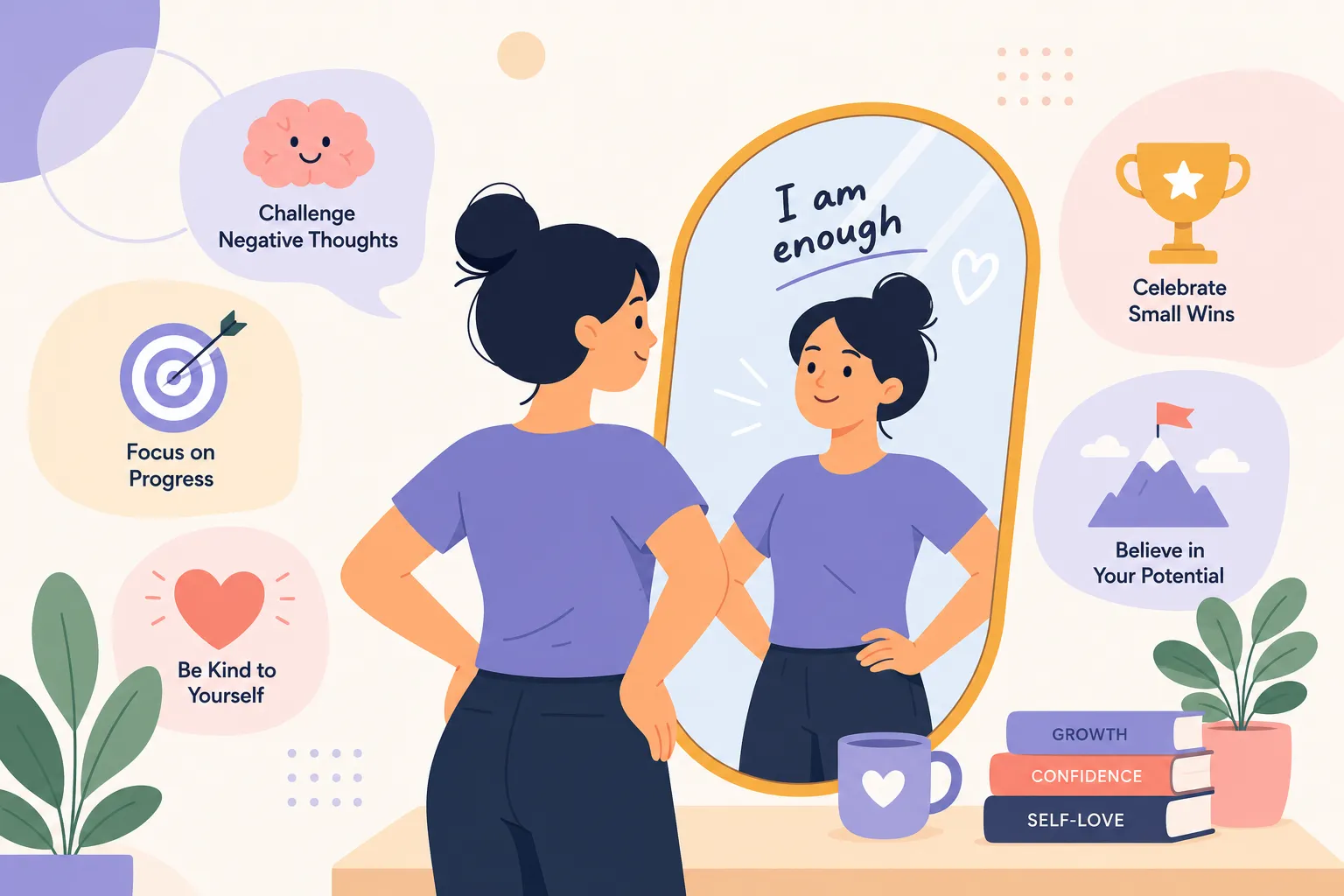
You know the feeling. You’re mid-presentation, halfway through an email, or about to speak up in a meeting, and a quiet voice cuts in: you’re not actually good enough for this. It feels true. It feels like a warning. But it isn’t a warning. It’s a pattern, and patterns change when you consistently feed them different inputs. These practical tips to overcome self-doubt and build self-esteem work because they target that pattern directly, with small, repeatable actions that accumulate into lasting change.
At Qurabox, we build every guide around one standard: practical advice you can use today, not abstract theory that sounds good and sits on a shelf. This article delivers concrete, research-backed strategies organized into three categories, morning habits, mindset practices, and social habits, plus a 2-week action plan you can start immediately. By the end, you’ll know how to spot your personal triggers, use ready-made scripts to interrupt negative self-talk in real time, and recognize when everyday habits aren’t enough and professional support is the smarter move.
Why self-doubt keeps winning (and what actually stops it)
The thought loop that keeps you stuck
Self-doubt doesn’t survive on its own. It runs on a feedback loop. A negative belief, say, “I’m not qualified enough”, pushes you to avoid the situation. Avoiding it means you never collect evidence that you could handle it. The absence of that evidence confirms the original belief, and the loop tightens.
Cognitive behavioral therapy (CBT) describes this as the avoidance cycle: untested negative beliefs feel like facts because we never challenge them. You pass on a work opportunity and tell yourself it was just “not the right time,” when the real reason was fear of exposure. The belief stays intact, unchallenged. That’s the mechanism self-doubt uses to stay alive.
How to spot your personal self-doubt triggers
Self-doubt doesn’t spike randomly. For most people, it clusters around three contexts: performance situations (presenting, being evaluated), social judgment (meeting new people, expressing opinions), and comparison (watching someone else succeed). Your pattern probably leans heavier on one of these than the others.
A useful starting exercise: pull out a notebook and answer this question honestly, “What situations tend to make me doubt my value or abilities?” Write down the first three that surface without editing them. These are your personal trigger zones, and everything that follows will hit harder once you know where your self-doubt actually lives.
Morning habits to build self-esteem and overcome self-doubt
1. Make one tiny promise and keep it
The most reliable confidence builder isn’t a big win. It’s a small, kept promise repeated daily. Choose something embarrassingly small: a 5-minute walk, one page read, one email sent. The size doesn’t matter. The consistency does. Every time you complete it, your brain registers evidence that you follow through, and that evidence accumulates into self-trust.
Behavioral activation research supports this directly: repeated, manageable completions rebuild the self-efficacy that chronic self-doubt erodes. A 2019 review in Clinical Psychology Review found that graded task assignment, starting with the smallest possible version of a behavior, was among the most reliable ways to interrupt avoidance patterns. Start so small that failure feels impossible; then build from there.
2. Start a daily wins log (2 minutes, no exceptions)
The human brain has a negativity bias. Left unchecked, it will catalog every stumble and overlook every success. A wins log is the manual override. At the end of each day, write one sentence: something you handled well, a problem you solved, feedback someone gave you. That’s it.
Over two weeks, those entries create a written record of competence you can review when self-doubt hits hardest. A simple format works: “Today I [specific action] and it [result or observation].” Rereading your log during a low moment can be more grounding than a motivational quote, because the evidence is specific to you and your actual experience. For added precision in tracking your progress, consider pairing your log with a validated measure like the Rosenberg Self-Esteem Scale, which takes under five minutes and gives you a baseline trend to watch.
3. Use a body reset before your first social interaction
Before a work call, a difficult conversation, or even your morning commute interaction, spend 30 to 60 seconds on this: posture upright, shoulders relaxed and back, slow deliberate breath, steady eye contact when the moment comes. Social psychology research on embodied cognition, including work by social psychologist Amy Cuddy and colleagues on postural feedback, suggests that slower speech pace signals to yourself and others that you’re grounded rather than reactive.
This isn’t “fake it till you make it.” It’s a physiological cue. Your body position and breathing pattern genuinely affect how you enter a situation, which affects how you perform in it, which feeds back into how you see yourself afterward.
Mindset practices to overcome self-doubt and silence the inner critic
4, 6. The catch-check-change method for negative self-talk
The core CBT technique for self-doubt has three steps, and the order matters:
- Catch the thought. Name it exactly: “I’m thinking I’m going to embarrass myself.”
- Check it for evidence. Ask: “Is this 100% true? What evidence supports this? What evidence contradicts it?”
- Change it to something accurate. Not a forced positive, but a realistic reframe: “I’ve handled situations like this before, and I can handle the next step.”
This loop doesn’t eliminate the inner critic in one pass. It trains you to treat self-critical thoughts as hypotheses to test rather than verdicts to accept. Practiced consistently, it genuinely weakens the pattern over weeks and is one of the most practical tips to overcome self-doubt and build self-esteem that the research supports. For a practical walk-through on recognizing and shifting negative self-talk, resources that show how to catch, challenge, and change your inner critic can be a useful companion to this method.
Short scripts to reach for in the moment
These aren’t affirmations. They’re interruptions, short phrases that break the automatic acceptance of a negative thought long enough for your rational brain to re-engage. Keep a few of these where you can see them:
- “I’m having the thought that I’m not good enough.” (Creates distance from the thought instead of fusing with it.)
- “Would I say this to a friend?” (If no, it’s too harsh for you too.)
- “This is hard, and I can still handle one next step.” (Acknowledges difficulty without collapsing into self-criticism.)
- “I can’t do this” becomes “How can I handle this?” (Shifts from verdict to problem-solving.)
- “What else could be true?” (Opens up a more balanced read on the situation.)
7. Self-compassion: respond to yourself like you would to a friend
Self-compassion isn’t softness. It’s one of the most effective tools for reducing the fuel that keeps self-doubt burning. When you normalize mistakes as part of learning rather than as evidence of permanent inadequacy, you remove the all-or-nothing framing that makes self-doubt feel like a verdict.
A practical way to build this: when you catch yourself spiraling after a mistake, ask what you’d say to a close friend in the same situation. Write it down. Then say it to yourself. Research by psychologist Kristin Neff, whose work established much of the modern framework for self-compassion, consistently shows that self-compassionate responses reduce shame-driven avoidance, the exact behavior that keeps self-doubt’s feedback loop spinning.
Social habits that quietly build self-worth
8, 9. Do one mild discomfort rep every day
Confidence isn’t built by thinking more positively. It’s built by collecting evidence that discomfort doesn’t equal danger. The practice is simple: once a day, do one thing that creates mild social discomfort. Speak up in a meeting. Ask a question you’d normally swallow. Start a brief conversation with someone new.
The emphasis on “once” is intentional. This isn’t about overwhelming yourself. Think of it as a daily rep, the same way you’d approach physical exercise. Each completed rep adds a data point: you entered the uncomfortable situation, and you survived it. That accumulated data is what self-esteem is actually made of, and it’s how you boost confidence in ways that stick.
10. Cut the comparison fuel
Limiting social media exposure isn’t avoidance. It’s input management. When your feed consistently surfaces curated highlight reels from people in your field or peer group, the CBT and self-compassion work you’re doing gets undercut at the source. Unfollow accounts that reliably trigger comparison. Redirect attention toward tracking your own progress against your own baseline.
This one adjustment protects the gains you’re building with every other habit on this list. Think of it as removing a slow leak from a tire you’re actively trying to inflate. Managing comparison is a practical strategy to increase self-worth that requires almost no extra time, just intentional boundaries around what you consume.
11, 12. Imposter syndrome: a quick reality check for work and school
Imposter syndrome differs from ordinary self-doubt in one key way: it persists despite evidence of competence. You get the promotion or the grade and still attribute it to luck. The doubt doesn’t lift with success because the internal logic discounts success as an input.
In workplace settings, the most targeted move is to track specific wins in writing and ask for direct, concrete feedback rather than global reassurance, “Was my presentation clear?” rather than “Do you think I’m doing well?” In academic settings, a mentor who can reality-check your self-critical interpretations against actual evidence is one of the most consistently supported tools in the imposter syndrome literature. In both cases, the goal is the same: replace self-generated “I was lucky” narratives with documented, external data.
Your 2-week plan to build self-esteem (with a self-check at the end)
The daily checklist for weeks 1 and 2
The biggest mistake people make with habit change is trying to implement everything at once. Start narrow and build.
- Week 1: One tiny daily promise. One wins log entry each evening. Nothing else.
- Week 2: Keep Week 1 habits. Add one mild discomfort rep each day and one 60-second body reset before your most challenging daily interaction.
Four habits total by the end of Week 2. That’s the foundation. Everything else, the scripts, the comparison cuts, the imposter syndrome check, layers on top once this base is running automatically.
3 self-assessment prompts to measure real progress
At the end of Week 2, set aside 10 minutes and work through these prompts honestly:
- Capability check: On a scale from “Incapable” to “Capable,” where would you mark yourself compared to two weeks ago? Look for directional movement, not perfection.
- Behavior check: What’s one situation you handled differently this week than you would have two weeks ago? Write the specific scenario.
- Method check: What self-critical thought did you successfully interrupt, even once, using the catch-check-change method?
These prompts aren’t about grading yourself. They’re about making the change visible so you have evidence that the work is actually working. For a more structured baseline, validated tools like the Rosenberg Self-Esteem Scale or the State Self-Esteem Scale are free and straightforward, useful for tracking trends over time, though not a substitute for clinical assessment. That evidence is the foundation your self-esteem gets built on.
When self-doubt needs more than habit hacks
Signs it’s time to bring in professional support
Daily habits work well for the self-doubt most adults experience. But some readers are dealing with something that sits deeper: clinical anxiety, depression, or chronic low self-esteem patterns that habits alone won’t resolve. Recognizing the difference matters.
Consider talking to a clinician if you notice any of the following persisting for more than a few weeks and interfering with daily life:
- Persistent low mood, hopelessness, or emotional numbness that doesn’t lift
- Social withdrawal that’s increasing over time
- Self-doubt that’s actively interfering with work, relationships, or daily functioning
- Symptoms including sleep disruption, appetite changes, or persistent anxiety
These aren’t signs of weakness. They’re clinical signals that a more targeted intervention, therapy, CBT for improving low confidence with a trained professional, or a conversation with your doctor, will be more effective than habit-building alone. Reaching out for that support is itself a confidence-building action, and evidence that you take your wellbeing seriously enough to act on it.
Start here: practical tips to overcome self-doubt and build self-esteem that actually stick
Self-doubt is a pattern. Patterns change through consistent, small actions applied over time, not through a single breakthrough moment. The three pillars covered here work together: morning habits that create early evidence of capability, mindset practices that interrupt the thought loop, and social habits that expand your tolerance for discomfort. Together, they gradually shift the internal data your brain uses to evaluate your worth.
Don’t try to implement everything at once. Pick two habits from this list, the tiny daily promise and the wins log are the lowest-friction starting point, and run those for seven days before adding anything else. This kind of practical, no-fluff approach to everyday self-improvement is exactly what the guides at Qurabox are built around, whether the topic is building better habits, managing your home, or handling your first camping trip solo.
Use these practical tips to overcome self-doubt and build self-esteem starting tomorrow. Pick one habit. Start it in the morning. That’s the whole plan.
Frequently asked questions
How long does it take to see real changes in self-esteem?
Most people notice small but measurable shifts within two to four weeks of consistent effort, which is why the plan above starts there. Meaningful, durable changes in self-esteem typically take several months of maintained habits. Progress is rarely linear; expect some setbacks, and use your wins log to track the overall direction rather than individual days.
When should I seek therapy instead of using self-help strategies?
If self-doubt is significantly interfering with your work, relationships, or daily functioning, or if you’re experiencing persistent low mood, anxiety, or hopelessness that doesn’t ease after a few consistent weeks of effort, it’s worth speaking with a mental health professional. Self-help strategies and therapy aren’t mutually exclusive; many people use both. A licensed therapist can provide structured CBT that goes deeper than habit-building alone.
Are these strategies effective for imposter syndrome specifically?
Yes. The catch-check-change method and the wins log are particularly useful for imposter syndrome because they create a written record that directly counters the “I was just lucky” narrative. Concrete, documented evidence is harder for the brain to dismiss than general reassurance. Pairing these habits with specific feedback-seeking at work or school targets the imposter syndrome pattern most directly.